


Branding / FICTORA FIELD NOTE
Rebranding a UAE Business in 2026: A Decision Framework
When to rebrand a UAE business, when to refresh instead, what breaks in the process, and how to sequence the change without losing customers or search visibility.
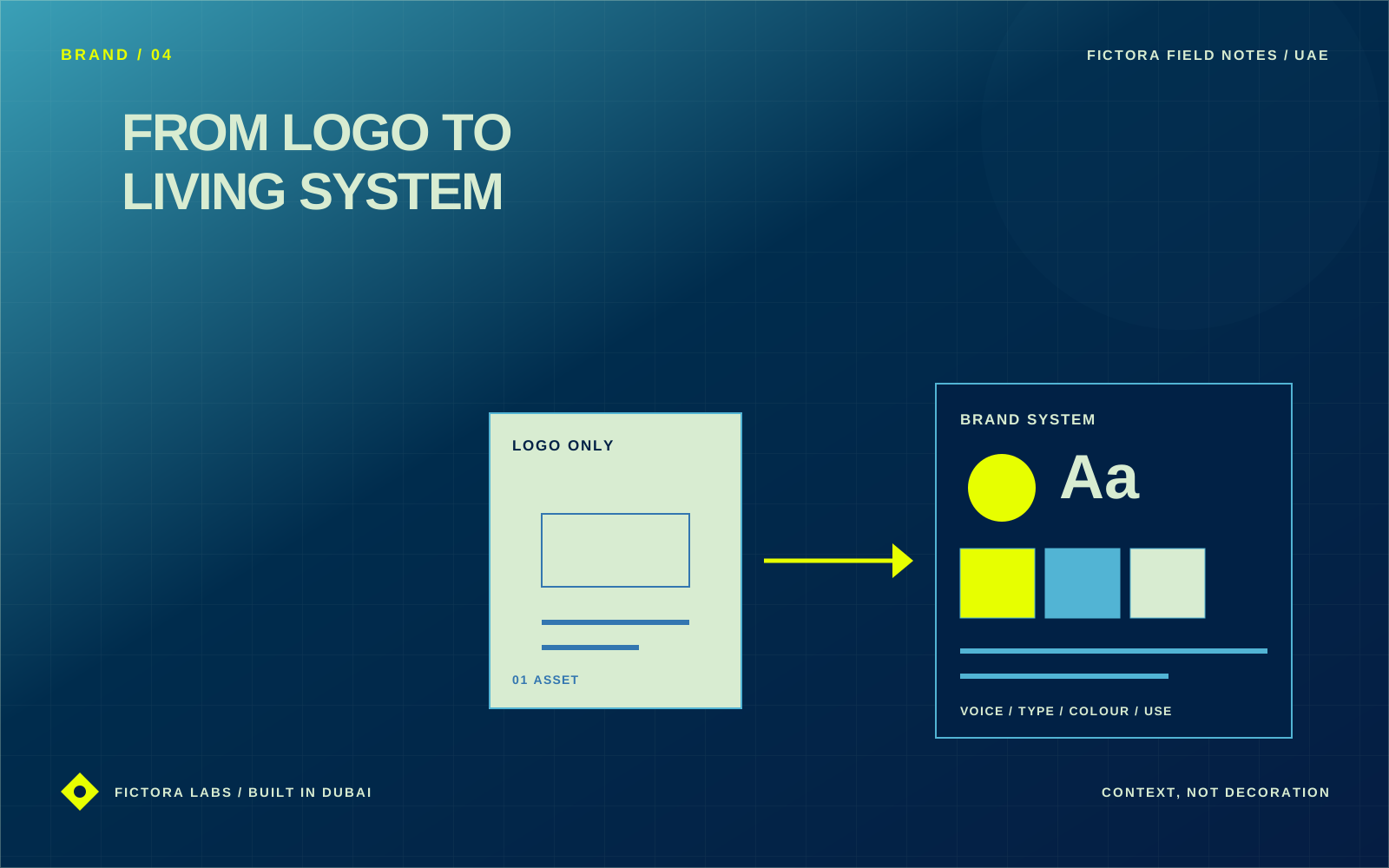
Every UAE business owner has been sold a rebrand they did not need. A new logo, a fresh colour palette, a website refresh — dressed up in language that promises a step-change in how the market sees the business. Six months later the founders quietly admit that customers still describe them the same way, and revenue has not moved.
Rebranding is a serious commercial decision. Done for the right reasons, at the right time, with the right sequence, it changes what the market believes about a business. Done for the wrong reasons, it destroys search visibility, confuses existing customers, and burns internal energy without paying it back.
This guide is a decision framework — when to rebrand a UAE business, when to refresh or reposition instead, what breaks during the process, and how to sequence the change without losing the customers or the search rankings the business already has.
The Question Before the Rebrand: What Does the Market Actually Believe?
Before deciding whether to rebrand, do the audit that most rebranding conversations skip: find out what customers, prospects, and the wider market currently believe about the business.
The cheap version of this audit is five specific outputs:
- Five recent customer conversations — not testimonials, actual conversations. How did they describe the business to their own colleagues? What did they think they were buying before signing? What surprised them after?
- Five lost-deal debriefs — call the last five prospects who chose someone else. Ask why. The pattern is almost never "the logo".
- The Google Search Console query report — the top 100 queries the business ranks for. If those queries do not describe the business the founders think they are running, that is a positioning problem, not a design problem.
- An AI answer engine mention audit — ask ChatGPT, Perplexity and Google's AI Overviews who the top providers in the category are. See if the business is named. The gap is your GEO opportunity, covered in the GEO and AEO guide.
- An internal alignment check — ask three senior people to describe the business in one sentence. If the sentences disagree, the market's confusion is starting inside the building.
If these five outputs point to a positioning problem, a rebrand may be the right instrument. If they point to a website usability problem, a sales process problem, or a customer experience problem, a rebrand will not fix the actual issue.
The Five Legitimate Rebrand Triggers
Not every unhappy season is a rebrand trigger. These are the five patterns where rebranding is the correct — sometimes the only — response.
1. Positioning Shift
The business has evolved past what the current identity claims. A company that started as "the automation agency" has become "the automation platform for a specific vertical". A firm that positioned as "the affordable option" is now competing on outcomes and can no longer afford the value-signalling of the old identity. The market's current picture of the business is behind the business's actual capability.
This is the most common legitimate trigger and the one worth the investment.
2. Category Change
The business has stopped serving one category and started serving another. A traditional web development agency that has become an AI-first product studio is no longer competing against WordPress shops — it is competing against product engineering firms. The identity, positioning, and vocabulary need to move with it.
UAE examples of this pattern in 2025–2026: several established digital agencies have shifted from "SEO and web" toward "AI systems and automation", requiring category-appropriate identity.
3. Merger, Acquisition, or Legal-Entity Change
Two businesses have combined, or the ownership structure has changed enough that the old identity misrepresents who is now running the company. In the UAE this frequently coincides with a change in the DED trade name registration or a move between free-zone jurisdictions (DIFC to ADGM, or mainland to a free zone), which forces the legal-entity change to be reflected outward.
4. Regulatory or Compliance Change
The market the business serves has moved into a regulated category that the current identity cannot sit inside. Fintech is the clearest UAE example — a payments-adjacent product that is now under the Central Bank's Retail Payment Services and Card Schemes Regulation, or a wealth-adjacent product now under DIFC or ADGM regulator supervision, needs an identity that reads as regulated-grade to the counterparty. The UAE PDPL (Federal Decree-Law No. 45 of 2021) has also shifted what "trustworthy" looks like across every business handling personal data.
5. Generational Identity Gap
The identity was built for a market that no longer buys the way the business needs it to. A brand built for print-first, English-only, executive audiences may need to move toward a digital-first, bilingual, mobile-first identity as the buyer generation shifts. UAE businesses in particular have to reflect the actual demographic and language mix of their customer base.
When Not to Rebrand
These are the situations where rebranding will not solve the actual problem, and will usually make it worse.
The website looks dated. If the identity is sound but the website is old, redesign the website. A rebrand is a heavier tool than the problem needs.
Sales are slow. If sales are slow, the answer is usually in the sales process, the pricing, or the offer — not the identity. A rebrand mid-slow-quarter also removes the founders' attention from the actual sales work.
A competitor launched something. Rebranding in reaction to a competitor is almost never the right move. If the competitor's positioning is genuinely better, respond with clearer positioning of your own; do not chase the visual.
The team is bored. Internal fatigue with the identity is not the market's fatigue with it. Customers pay less attention to the visual than the founders do. Freshen individual assets before touching the identity system.
An investor or board member suggested it. The strongest signal a rebrand is being commissioned for the wrong reason is that the pressure is coming from someone whose attention on the business is intermittent. Get the audit done before agreeing.
What Breaks During a Rebrand
Every rebrand introduces short-term friction. Naming it in advance is the difference between a rebrand that ends stronger and one that quietly loses ground.
Search Visibility
The largest and most under-planned cost of a rebrand. Every URL change is a discovery reset. Every meta description rewrite is a re-evaluation event. Every H1 shift is a signal change to Google. If the domain also changes, brand-query traffic collapses for weeks while Google re-associates.
The mitigation: run URL changes through one-hop 301 redirects, preserve internal linking targets, keep the sitemap current, and time the rebrand around a period when brand-query volume is not your primary lead source. The technical SEO guide covers the redirect and canonical health discipline in detail.
Customer Confusion
Existing customers were sold on the old identity. They will not read the launch announcement. They will see a different-looking email and wonder if it is phishing. They will bookmark the old URL and hit a 404. The mitigation is a two-touch campaign to the active customer list explaining the change, why, and what stays the same — before the launch, and again on the day it goes live.
Internal Ownership and Assets
Every sales deck, every proposal template, every email signature, every invoice template, every social media profile, every third-party listing — DED trade licence records, Google Business Profile, DIFC / ADGM member directories, DFHQ community listing, LinkedIn Company Page, industry association memberships — all need to be updated. Missing any one of these creates a "half-rebranded" appearance that reduces trust more than the old identity did.
The mitigation is an asset inventory built before the launch date and a named owner for each asset category, with a hard cutover deadline everyone commits to.
Legal Documents and Contracts
If the legal entity changes at the same time as the brand, existing contracts, letters of engagement, MSAs, NDAs, and standing invoices all reference the old entity. UAE contract enforcement expects the correct legal name to appear consistently. Coordinate with legal counsel before any customer-facing rebrand asset ships.
The First 90 Days of Metrics
Impressions, organic traffic, direct traffic, referral traffic and paid conversion cost will all move in the first 90 days after a rebrand. Not all movement means the rebrand failed. Establish the pre-rebrand baseline (28-day rolling averages) and hold judgment on outcomes until the 91–120 day window. Making decisions inside the first 90 days is how good rebrands get killed.
UAE-Specific Complications
Bilingual identity. If the business serves both Arabic and English audiences, the rebrand has to work in both. This is not translation — Arabic wordmarks, right-to-left composition, calligraphic tradition, and Gulf typographic sensibility all matter. Machine-translated identity work reads as machine-translated to Arabic speakers.
DED trade name registration. If the rebrand includes a name change, the DED trade name registration and licence renewal need to sequence with the customer-facing launch. Getting this wrong creates a period where the business's public identity does not match its licence — a compliance issue for regulated categories.
DIFC / ADGM entity changes. If the business operates through a DIFC or ADGM entity, an entity-level change has its own regulator process with its own timeline. Coordinate the free-zone regulator, the mainland DED, and the customer-facing launch so all three land in a compatible sequence.
DFHQ and community perception. Fictora Labs is a DFHQ-recognised startup; several UAE startup businesses sit inside the Dubai Founder HQ community and other founder networks. Community perception forms quickly and unforgivingly around a rebrand. Preview the new identity to the community before the public launch — the goodwill costs almost nothing and the negative signal from a badly-managed community launch can cost a year of trust-building.
How to Sequence a UAE Rebrand
The sequencing pattern that works, in order:
- Audit — the five outputs described above. Two to four weeks. If the audit does not clearly point to a rebrand, stop here.
- Strategy — positioning, category, competitive frame, target market, and the brand promise as a single sentence. Four to six weeks. Signed off by the founders and, where relevant, board.
- Legal + regulatory sequencing — engage DED, free-zone regulator (if applicable), and legal counsel in parallel. Establish the launch window before design starts.
- Identity system — wordmark, palette, typography, application patterns, motion, tone of voice. Six to twelve weeks depending on scope. Bilingual work runs in parallel, not after.
- Asset inventory + migration plan — every asset, its owner, its cutover deadline. Two weeks.
- Website and search preparation — 301 redirect map, canonical updates, structured-data refresh, GSC change-of-address or hostname migration setup, sitemap regeneration. Two to four weeks.
- Customer communication — two-touch campaign to active customers before launch. One week.
- Launch day — coordinated go-live across all customer-facing surfaces on one working day (not on a Friday — the UAE weekend absorbs the launch signal).
- Ninety-day observation window — hold judgment. Track the metrics. Adjust asset-level details, not strategic positioning.
- Ninety-one-day review — measure against the pre-rebrand baseline. Now the decisions about what worked and what needs adjustment can be made honestly.
When a Refresh Solves It Instead
If the audit points to visual fatigue rather than a positioning problem, a refresh — updating typography, tightening the palette, refreshing the wordmark, modernising the website — solves the actual problem at a fraction of the cost and disruption. Refreshes do not require legal-entity coordination, do not reset search rankings, and do not confuse existing customers.
Signs a refresh is the right answer:
- Customers describe the business accurately, but say the visual looks dated.
- The sales process converts, but the marketing collateral feels off-brand.
- The core proposition is unchanged, but individual applications have drifted.
- The team is proud of the strategy, embarrassed by the execution.
A refresh done well every three to four years usually delays the need for a full rebrand by another cycle.
What Fictora Labs Ships Under Each Path
When we brief a UAE client, the first output is the audit — the five items described above, adapted to their business. That output determines whether the engagement continues as a rebrand, a refresh, or a repositioning-without-visual-change. We would rather lose the design revenue than sell a rebrand a business does not need.
When a rebrand is the right answer, we sequence it as ten steps above. The identity work runs on the brand system pattern documented in the how AI is changing brand identity field note. The commercial framing sits inside the professional branding for UAE businesses guide, which uses Global Syndicate and Zena AI as worked examples.
Fictora Labs is a DFHQ-recognised AI automation and digital marketing agency based in Dubai. Our branding service covers audit, positioning, identity system, bilingual application, and the search and asset discipline that keeps a rebrand from losing what the old brand already earned.