


SEO / FICTORA FIELD NOTE
GEO and AEO for UAE Businesses: How AI Answer Engines Change SEO in 2026
How Fictora Labs approaches GEO and AEO for UAE businesses: what to add to your site to earn citations in ChatGPT, Perplexity and Google's AI Overviews.
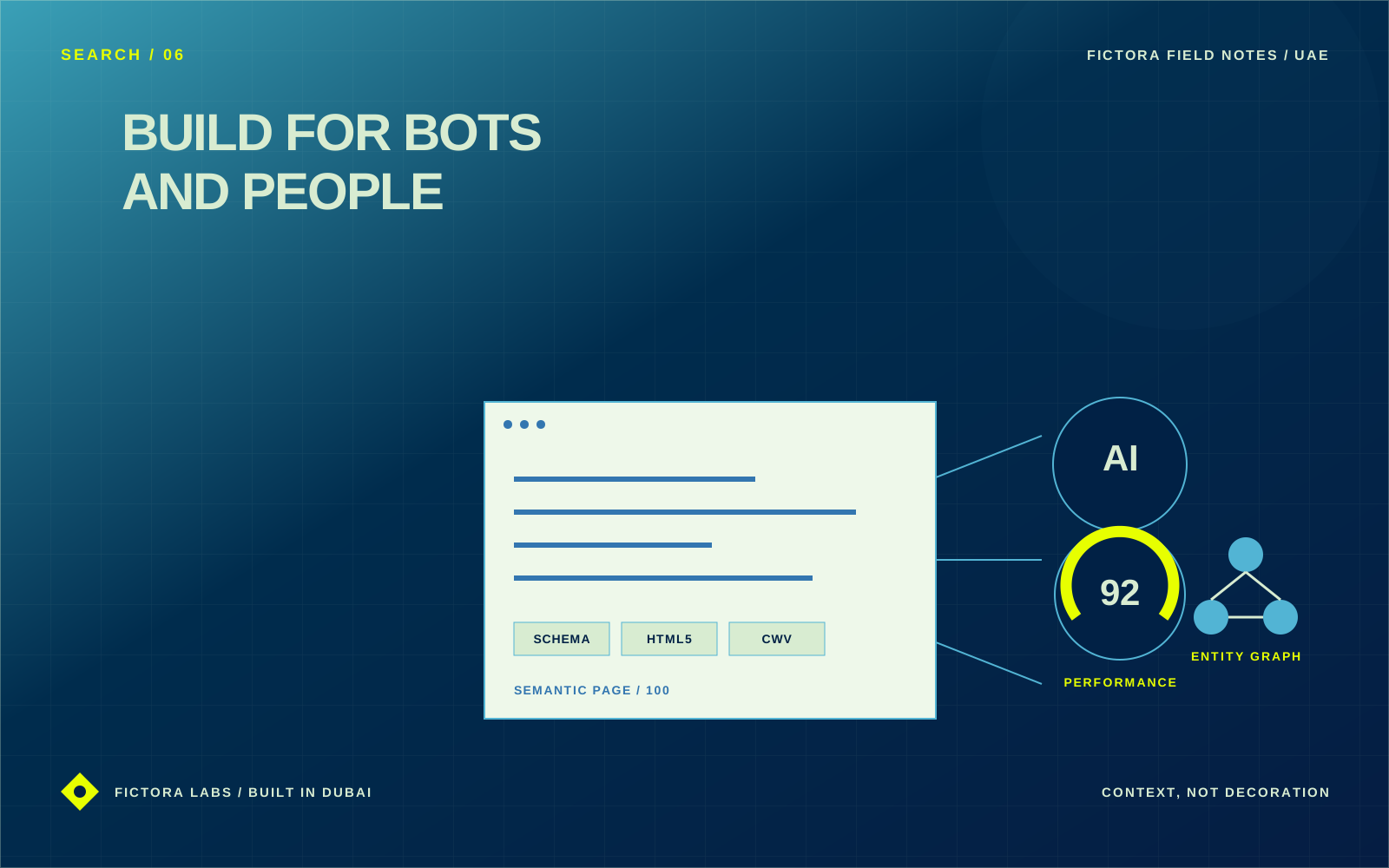
Every UAE business owner watching a customer type a question into ChatGPT, Perplexity, or the AI Overviews box at the top of a Google search is watching search behaviour change in front of them. The customer is not clicking through to ten blue links any more. They are reading an answer, and either accepting it or asking a follow-up.
Two disciplines respond to that shift: Answer Engine Optimisation (AEO), which structures content so it can be extracted as an answer, and Generative Engine Optimisation (GEO), which shapes how a business shows up inside AI-generated responses. Both sit on top of traditional SEO fundamentals — they do not replace them — but they change what you measure and how you write.
This guide covers what UAE businesses need to add, remove, and measure in 2026 to earn visibility across Google's AI Overviews, ChatGPT with browsing, Perplexity, Claude, and Copilot. It reflects the discipline Fictora Labs applies to its own site and to client work.
What Is AEO, What Is GEO, and How Are They Different?
The two terms overlap and often get used interchangeably. The useful distinction:
- Answer Engine Optimisation (AEO) is about earning extraction. Your page contains a well-formed answer to a specific question; a search engine or AI system reads it and pulls that answer into a rich result, featured snippet, or an AI summary with a citation.
- Generative Engine Optimisation (GEO) is about showing up favourably inside AI-generated responses. Your brand, your product, your point of view appears in the answer the model synthesises — with or without a link back to your site.
AEO earns you the click when the AI decides to cite a source. GEO earns you the mention even when the AI decides to answer without linking anywhere. Both matter, and neither works without the traditional SEO foundations of clean semantic HTML, valid structured data, fast pages, and a trustworthy internal link graph.
Where UAE Customers Actually Encounter AI Answers in 2026
The AI-answer surface for a UAE business is not one product; it is a set of overlapping ones, and each behaves differently:
- Google AI Overviews — the summary panel above traditional search results, live in the UAE since 2024 and expanding across query types. Draws on Google's own index plus its Gemini models. Sources cited via linked chips.
- ChatGPT with browsing — inside the ChatGPT product, the model retrieves pages via OAI-SearchBot and ChatGPT-User user agents, cites them inline. Widely used by UAE professionals for research.
- Perplexity — a native answer engine that leads with citations. PerplexityBot crawls sources; the product surfaces them prominently.
- Claude — Anthropic's assistant. ClaudeBot indexes content; the assistant can search the web where enabled.
- Microsoft Copilot — draws on the Bing index plus OpenAI models. Cites sources inline.
Different surfaces reward different signals. Perplexity favours pages with obvious primary sources. Google AI Overviews leans on already-ranking pages and heavily on entities Google understands. ChatGPT with browsing tends to prefer authoritative, recent, well-structured content. Building for the union of these systems is what AEO and GEO actually look like.
The Five Shifts UAE Businesses Should Make in 2026
None of these replaces traditional SEO. They sit on top of it.
1. Structured Data Becomes Evidence, Not Decoration
Schema.org markup used to be a nice-to-have for rich results. In 2026 it is how AI systems distinguish a business page they can trust from one they cannot. Every UAE service page should ship valid Service, Organization, and LocalBusiness schema with real values — not placeholder addresses or generic descriptions. Every article should ship Article with a real author, datePublished, and dateModified. Every FAQ block should ship FAQPage with visible copy that matches the markup exactly.
Validate at the Schema.org validator and Google's Rich Results Test. Broken JSON-LD is a signal that reduces trust across the board.
2. Answer-Shaped Content Earns Citations; Keyword-Stuffed Content Does Not
An AI system can only cite a page if it can extract a specific answer. Pages that spend three paragraphs before answering the question in the H1 get skipped in favour of pages that answer in the first sentence and then unpack.
The practical rule: for any content targeting a query, write the direct answer in the first 60 words of the section. Everything after that is context, evidence, and elaboration. Use question-format H2s for queries you want to be cited on. If a claim is quantified, link the primary source immediately, not in a footnote.
3. Named Entities and Primary Sources Beat Keyword Density
Language models understand relationships between named entities — organisations, laws, products, cities, standards. A UAE business page that names "Federal Decree-Law No. 45 of 2021" instead of generic "UAE data protection law" earns higher confidence with any model that has been trained on the actual regulatory corpus.
Same principle for products (say "Zena AI" or "n8n", not "our chatbot" or "an automation tool"), places (say "DIFC" and "ADGM", not "free zones"), and standards (say "WhatsApp Business Platform", not "official WhatsApp API" — the platform's actual name is the Business Platform now). Precision reads as authority. Vagueness reads as filler.
4. Freshness Matters More Than It Used To
LLM-based answer engines heavily favour recent content on time-sensitive topics. UAE regulatory landscape in particular changes fast — the FTA e-invoicing timeline shifted twice in 2025, DIFC Data Protection Law was amended in early 2025 to add AI-specific rules, and the PDPL executive regulations continued to evolve through 2025. A well-optimised page from 2023 will still lose to a competently updated page from three months ago.
Keep a dateModified that reflects real editorial refreshes, not build-time regeneration. Actually update the content when the regulation shifts. This is why a real content approval workflow matters — it keeps refresh discipline out of the "one day I'll get to it" pile.
5. Brand Mentions Across the Web Feed the Model, Not Just Backlinks
Traditional SEO valued backlinks. LLM training and retrieval-augmented generation both value mentions — a business being talked about in industry conversations, community posts, credible directories, and news coverage. Not everything the AI knows about your business comes from your own site.
Practical action for UAE businesses: keep an accurate Google Business Profile, a real LinkedIn company page, verified profiles on directories that actually get cited (industry associations, DIFC / ADGM member listings, DFHQ community listings), and consistent NAP data across all of them. This is local SEO territory, but with an AEO/GEO twist: mentions that appear in the pages LLMs read matter as much as backlinks that pass PageRank.
The Technical Prerequisite: AI Crawlers Must Be Allowed
None of this works if your robots.txt blocks the crawlers doing the reading. The current-best-practice allow-list for a UAE commercial site in 2026 is:
User-agent: GPTBot
Allow: /

User-agent: OAI-SearchBot
Allow: /

User-agent: ChatGPT-User
Allow: /

User-agent: ClaudeBot
Allow: /

User-agent: PerplexityBot
Allow: /

User-agent: Google-Extended
Allow: /

User-agent: Applebot-Extended
Allow: /

Sitemap: https://yoursite.ae/sitemap.xml
The technical SEO guide covers the rest of the crawl-access stack. Being crawled is a prerequisite for being cited; nothing on this page matters if the door is closed.
Bilingual Answer Optimisation for UAE Audiences
UAE customers ask questions in Arabic, English, and mixed both. Answer engines increasingly handle bilingual questions well, but they still favour pages that unambiguously identify their target language and audience.
Practical shape for UAE businesses:
- If you publish an Arabic version of the same content, use
hreflangannotations to declare it (ar-AEfor UAE Arabic,en-AEfor UAE English). Do not machine-translate an English article and call it Arabic content — Arabic-language answer engines and Arabic-speaking users detect this immediately. - If you only publish in English but serve UAE customers, keep every regulatory, geographic, and commercial reference explicitly UAE-scoped in the first paragraph so the AI extractor knows the answer applies to the UAE market, not a generic global answer.
- For bilingual sites, publish the primary sources you cite in the version of the article that references them — do not force Arabic readers through an English source to verify a claim.
How to Measure AEO and GEO
Traditional SEO measures positions, clicks, and impressions. AEO and GEO layer on top of that:
- Citation surface — is your page appearing as a cited source in AI Overviews, Perplexity answers, and ChatGPT-with-browsing responses on your target queries? Test manually against a query bank; there is no automated dashboard for this yet that is universally reliable.
- Brand mention surface — is the model naming your business when asked "who are the AI automation agencies in Dubai" or "best marketing automation agency UAE"? Test across the models your customers actually use. The gap between what the model says and what your service page says is your GEO opportunity.
- Freshness cadence — count how many of your top-20 commercial pages have a
dateModifiedthat reflects a genuine content refresh within the last 90 days. The number is almost always lower than teams estimate. - Structured-data coverage — count the pages where Google Search Console's Enhancements report shows valid FAQ, Service, Organization, or Article markup with zero warnings. Growing this coverage compounds over time.
- Answer-shape audit — read your top-20 pages against the "does the H1 answer the query in the first 60 words" rule. Most sites fail this on more than half the audit set.
Common Failure Modes
Blocking AI crawlers by default. Many CMS platforms and hosting defaults still ship a robots.txt that omits the newer crawlers. Check yours before writing a single word of GEO copy.
Machine-translating for bilingual audiences. Arabic answer engines and Arabic-speaking users spot machine translation instantly. It reduces trust rather than expanding reach.
Chasing every new AI product with a separate strategy. The underlying signals — clean structured data, direct answers, named entities, freshness, brand mentions — are shared across every AI answer engine currently in market. Optimise for the signals, not the product.
Writing for the model, not the reader. Content that reads as machine-optimised loses the human. AI systems trained on human feedback increasingly downweight pages that read like they were written for a scraper. Write for the person who will act on the answer; the AI will follow.
Skipping the boring measurement. Most teams love the strategic conversation about AI answer engines and skip the weekly cadence of actually testing queries in each surface. The measurement is where the improvement comes from.
How Fictora Labs Runs AEO and GEO for Its Own Site
The discipline on this site is the same shape we ship for clients. Every commercial page carries valid Service, Organization and where relevant LocalBusiness schema, validated at build. Every article carries Article markup with real author, published, and modified dates that reflect actual editorial refreshes. Every FAQ block has visible copy that matches its schema exactly — the automation hub's eight FAQs match its FAQPage markup entry-for-entry.
Named entities lead: we say Federal Decree-Law No. 45 of 2021, DIFC Data Protection Law No. 5 of 2020, WhatsApp Business Platform, n8n, Notion, Zena AI — not generic paraphrases. Primary sources are linked inline the moment a quantified claim appears, not stashed in a footnote or omitted. The robots.txt allows every current AI crawler.
The measurement discipline is a weekly URL Inspection sweep of the full sitemap plus a 28-day Search Performance snapshot, with the state persisted to disk and hash-pinned in our operating plan. When a page slips from indexed to unknown, we know within seven days. When a service page starts absorbing queries a commercial page should own, we know from the page/query table before an owner has to notice traffic softness.
Where to Take This Next
If you are starting from a technical foundation problem, work through the technical SEO guide for UAE businesses first. If your local visibility is the priority, the local SEO in Dubai guide covers Google Business Profile, NAP consistency and area-specific content signals. If content operations are the blocker to running a freshness cadence, the content approval automation guide documents the workflow behind editorial refresh discipline.
Fictora Labs is a DFHQ-recognised AI automation and digital marketing agency based in Dubai. Our SEO, AEO and GEO service covers structured data implementation, entity clarity, freshness cadence, AI crawler access, and the citation-tracking discipline described above.