


SEO / FICTORA FIELD NOTE
Technical SEO for UAE Businesses in 2026: AI Crawlers, Schema and Core Web Vitals
Google's bot isn't the only crawler that matters anymore. Here's how UAE businesses need to configure their technical SEO in 2026 — from robots.txt to schema to Core Web Vitals.
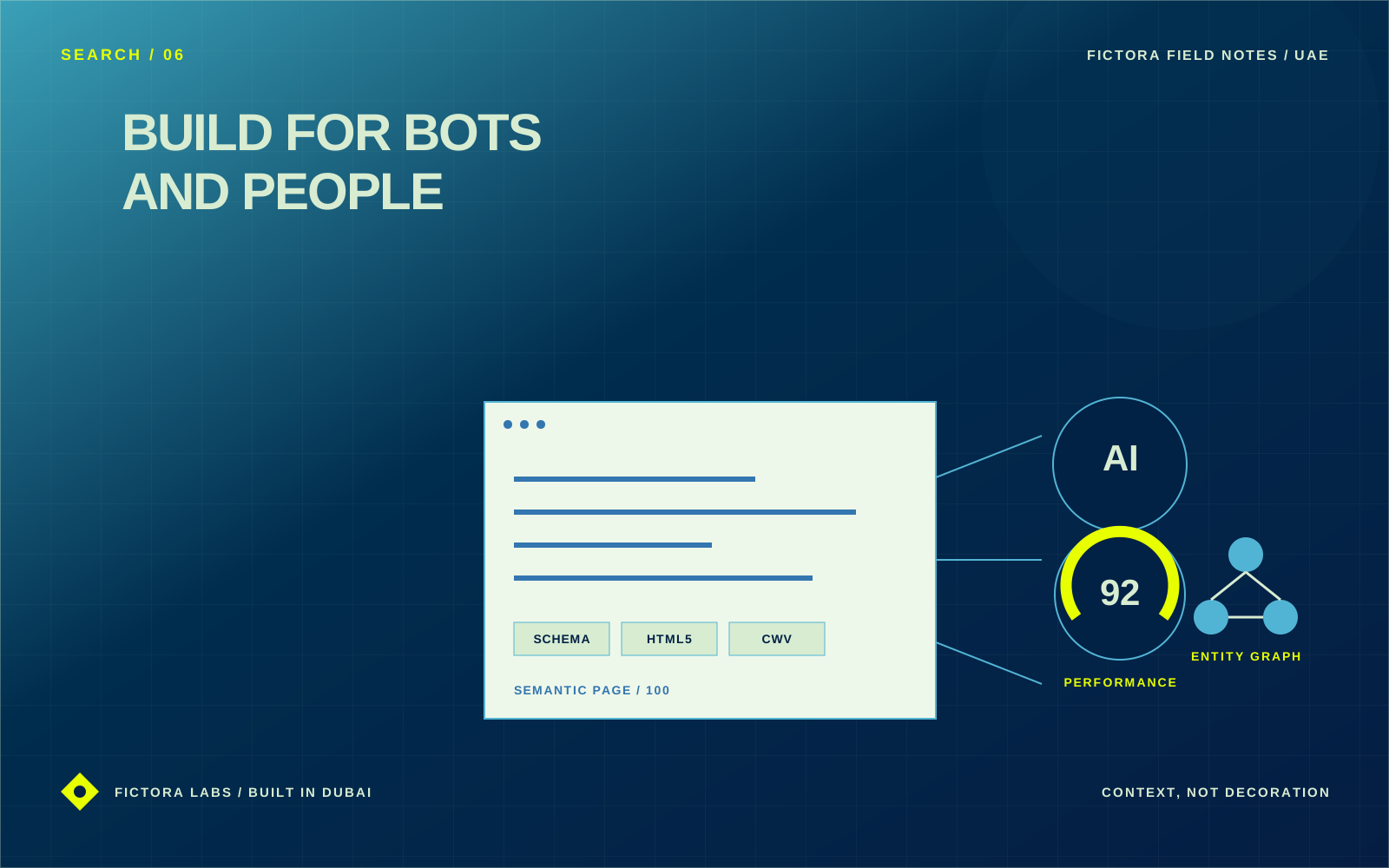
Google's bot is not the only crawler that matters anymore.
By 2026, business websites are also being read — and increasingly cited — by a new generation of AI crawlers: OpenAI's GPTBot and OAI-SearchBot, Anthropic's ClaudeBot, PerplexityBot, Google-Extended (Google's opt-out signal for its AI features), and Applebot-Extended (Apple's equivalent). If your robots.txt file, page headers, or CMS defaults inadvertently block them, you are absent from the AI-generated answers your customers already see.
AI crawlers benefit from the same fundamentals as traditional search bots: clean semantic HTML, valid structured data, fast pages, and a consistent internal link graph. Poor markup makes content harder to extract accurately, whichever bot is doing the reading.
This guide covers the technical SEO stack for UAE businesses in 2026 — from the fundamentals that have not changed to the AI-specific configurations most agencies still overlook. It is written for a modern stack; anything that is stack-specific is called out as such.
Make Sure AI Crawlers Can Access Your Site
The most common and immediately fixable technical error in 2026 is silently blocking AI crawlers in robots.txt. Check yours at yoursite.ae/robots.txt. A minimum configuration that permits the current-best-practice set of AI crawlers looks like this:
User-agent: GPTBot
Allow: /

User-agent: OAI-SearchBot
Allow: /

User-agent: ChatGPT-User
Allow: /

User-agent: ClaudeBot
Allow: /

User-agent: PerplexityBot
Allow: /

User-agent: Google-Extended
Allow: /

User-agent: Applebot-Extended
Allow: /

Sitemap: https://yoursite.ae/sitemap.xml
Cross-reference the file against any page-level noindex or X-Robots-Tag headers that might be silently blocking commercial pages. Being crawled is a prerequisite for being cited; nothing else in this guide matters if the door is closed.
HTML5 Semantic Structure — How AI Systems Read Your Pages
AI systems do not just read your text. They parse your page structure to understand the hierarchy and relationships between ideas on each page. A flat wall of content inside generic <div> elements is far less extractable than content that uses proper HTML5 semantic markup.
The minimum structure every content page needs:
<body>
  <header>...</header>
  <main>
    <article>
      <h1>Page topic</h1>
      <section>
        <h2>Major section</h2>
        <p>...</p>
        <h3>Sub-section</h3>
      </section>
    </article>
  </main>
  <footer>...</footer>
</body>
Three rules for UAE business websites:
Strict heading hierarchy — one H1 per page, H2s for major sections, H3s for sub-sections. Do not skip levels. AI systems use heading structure to build a semantic map of what each section is answering.
Use semantic landmarks — <header>, <main>, <nav>, <article>, <footer>. These help both accessibility tools and content extractors identify which region of the page carries the primary content.
Descriptive alt text on informational images — decorative images can use alt="", but any image conveying information (charts, diagrams, product photos) should describe what it shows. AI systems and screen readers rely on the same signal.
Core Web Vitals — Still Critical, Still Misunderstood
Google's Core Web Vitals are part of the Page Experience signals Google uses in ranking, and they correlate with how AI platforms treat web pages when quality is a citation filter. Slow, unstable pages are less likely to be cited well by either system.
- LCP — Largest Contentful Paint — target under 2.5 seconds
- CLS — Cumulative Layout Shift — target under 0.1
- INP — Interaction to Next Paint — target under 200 ms
LCP — Largest Contentful Paint — target under 2.5 seconds
The most common LCP failure is an uncompressed hero image. A 2 MB JPEG loading as the primary hero element will consistently fail LCP on mobile. The fix:
- Convert images to WebP or AVIF — Google's own guidance notes WebP is typically 25–35% smaller than comparable JPEG.
- Set explicit
widthandheightattributes on every image so the browser can reserve layout space before the image loads. - Use
loading="lazy"on below-the-fold images, but never on the hero image, which needs to load immediately. - Preload the hero image with
<link rel="preload" as="image">when it is the LCP element.
CLS — Cumulative Layout Shift — target under 0.1
Layout shift is caused by content that appears after the initial render pushes existing content down. The common culprits are:
- Images without explicit dimensions.
- Web fonts loading in and reflowing text — use
font-display: swapand preload critical fonts. - Late-injected banners, cookie notices, or ads. Reserve space for them.
INP — Interaction to Next Paint — target under 200 ms
INP measures how quickly the page responds when a user taps or clicks. Render-blocking JavaScript is the primary cause of poor INP. Defer any script that does not need to execute on initial render, split large bundles, and avoid running long tasks on the main thread. On any stack — WordPress, static, framework-rendered — the principle is the same: less blocking JavaScript on the critical path.
Schema Markup - The Language AI Systems Speak
Schema markup is structured data that tells AI systems exactly what your content is about in a machine-readable form. Without it, AI platforms must infer meaning from prose alone. With it, you provide explicit context that influences how content is processed, cited, and surfaced.
The priority schema types for UAE businesses in 2026:
Organization — establishes the business as an entity. Includes name, URL, logo, founding date, address, phone, and social profiles. This is how AI systems build their model of who your business is.
LocalBusiness — critical for "near me" queries and Google Maps visibility. Includes NAP, opening hours, and service area. For UAE businesses, set addressCountry to AE and reference AED where a price range is quoted.
FAQPage — each Q&A pair you mark up becomes eligible for AI-generated answers and rich results. Add it to any page with a genuine FAQ section, not by fabricating questions to trigger the markup.
Service — describes each service you offer, who it is for, and what geographic area it serves. Connects specific services to the Organization entity.
BreadcrumbList — tells crawlers where each page sits in the site hierarchy. Especially useful for nested paths such as /services/service-name/.
Implement each schema block as a <script type="application/ld+json"> in the page <head>. Most modern CMSes and static-site generators support this natively. Validate every block with Google's Rich Results Test before publishing.
XML Sitemap - What to Include and What to Block
Your XML sitemap is the map you hand to crawlers. What you include and exclude directly determines which pages get indexed — by Google and by AI platforms.
What to Include:
- Every public service page.
- Every published blog post.
- About, Contact, Portfolio, and any dedicated case-study pages.
- Location-specific landing pages where they exist.
What to Exclude:
- Admin, login, and API paths for whatever stack you run on.
- Thank-you and confirmation pages that only exist after a form submission.
- Tag, author, or paginated archive URLs that duplicate primary content without adding unique value.
- Anything currently returning a
noindexheader or meta tag — sitemap entries must be intended-indexable URLs.
Submit the sitemap in Google Search Console at its canonical path (typically yoursite.ae/sitemap.xml) and reference the same URL from robots.txt. Retire any legacy sitemap paths that no longer exist; a stale submission wastes crawl budget and can mask real coverage issues.
Hreflang — Essential for UAE Bilingual Sites
If your website serves both Arabic and English audiences, hreflang tags tell search engines and AI crawlers which language version to serve to which audience — reducing the risk of duplicate-content confusion and helping Arabic-speaking users land on the Arabic version.
Basic hreflang implementation in the <head> of each page:
<link rel="alternate" hreflang="en-AE" href="https://yoursite.ae/page/" />
<link rel="alternate" hreflang="ar-AE" href="https://yoursite.ae/ar/page/" />
<link rel="alternate" hreflang="x-default" href="https://yoursite.ae/page/" />
Include the x-default entry so search engines know which URL to fall back to when no language match applies. Combine hreflang with Organization schema on both language versions so AI systems attribute both to the same brand rather than treating them as separate sources.
Internal Linking — The Signal That Ties It Together
Key rules for UAE business websites:
Every blog post should link to at least one commercial service page within its opening paragraphs — not buried at the bottom as a CTA. Anchor text should be descriptive and keyword-relevant, not "click here" or "read more". No published page should be an orphan: every page needs at least one internal link pointing to it, or it is effectively invisible to crawlers that follow the link graph. Regularly audit for broken internal links, especially after URL changes.
Technical Audit Checklist — Run This Monthly
Working through this list monthly takes under an hour and catches the issues that silently erode rankings and AI-citation eligibility between campaigns:
- robots.txt — no accidental blanket disallows; AI-crawler user agents explicitly allowed; sitemap referenced.
- Sitemap — every URL returns 200; no
noindexURLs listed; no retired paths; submitted state in Search Console matches the file. - Core Web Vitals — CrUX report clean on mobile and desktop for LCP, CLS, and INP.
- Schema validity — every page's structured data passes Google's Rich Results Test with no errors.
- Hreflang — every language pair returns matching reciprocal tags;
x-defaultpresent. - Indexation — spot-check five commercial URLs in URL Inspection; investigate any that regress to Discovered or Crawled-not-indexed.
- Orphan pages — every URL in the sitemap has at least one incoming internal link.
- Mixed content and security — HTTPS everywhere, no insecure resources, valid certificate, HSTS as configured.
Ready for a Technical SEO Audit?
Fictora Labs conducts technical SEO audits for UAE businesses — covering AI-crawler access, Core Web Vitals, schema implementation, hreflang configuration, and everything in between. Every issue found is prioritised by impact and fixed systematically.
Request your free SEO audit →
Fictora Labs is a DFHQ-recognised SEO, AEO and GEO agency based in Dubai, UAE. Our AI workflow automation service also handles schema updates, sitemap maintenance, and reporting for businesses that want the technical stack to run without manual intervention.