


Branding / FICTORA FIELD NOTE
Why Professional Branding is Non-Negotiable for UAE Businesses in 2026
Branding is not a logo. Here is what a proper brand system delivers for UAE businesses, with two real Fictora Labs examples: Global Syndicate and Zena AI.
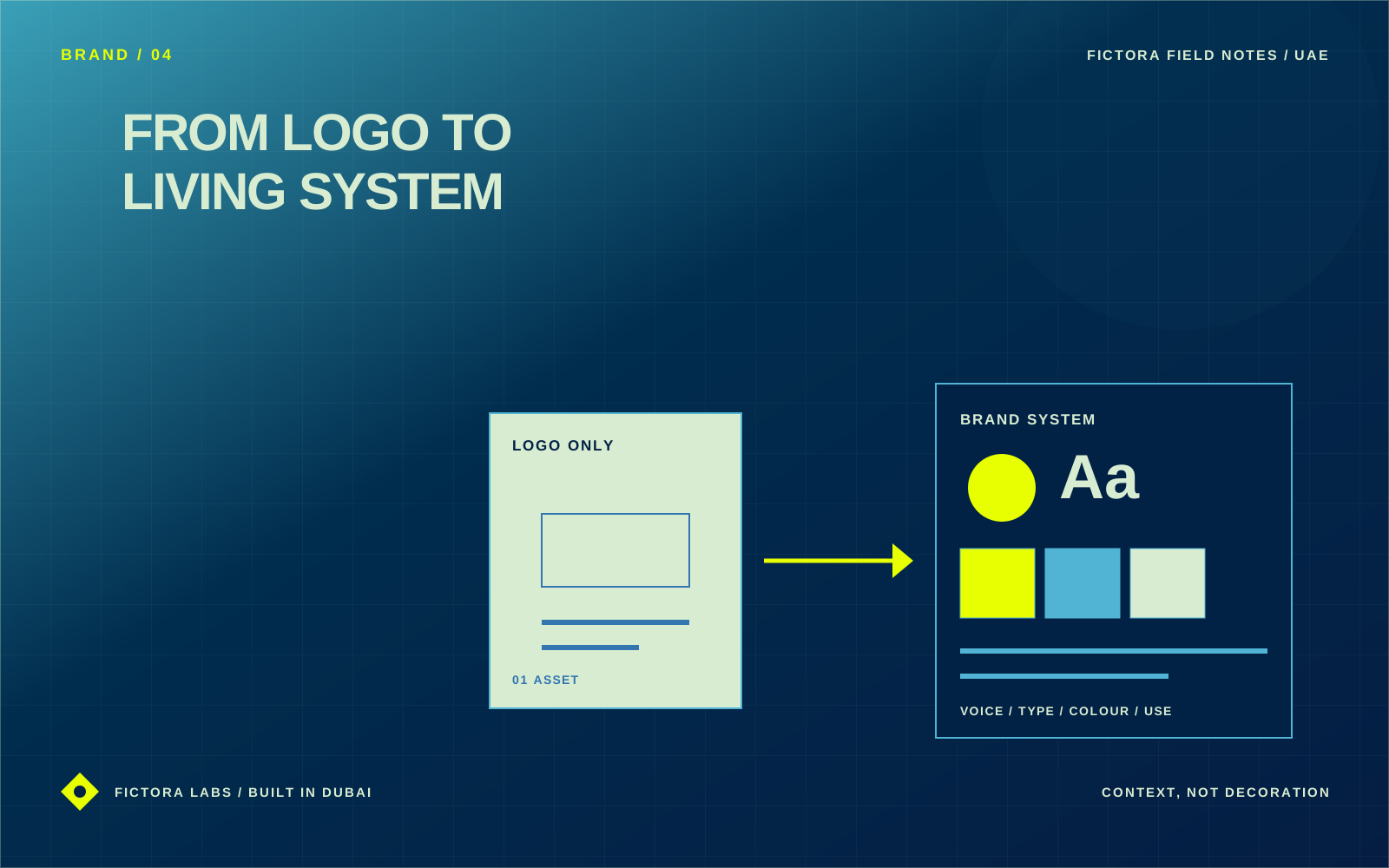
In Dubai, most businesses still treat branding as a logo exercise. A freelance logo, a website that carries it, and the assumption that the rest will follow. It rarely does. The businesses that win the accounts you never see are the ones that treat their brand as a system — positioning, visual identity, voice, and application rules — not a picture.
This piece walks through what "professional branding" actually means for a UAE business in 2026, why it matters more here than in most markets, and two real Fictora Labs projects — Global Syndicate and Zena AI — that show what the difference between a logo and a brand system looks like in practice.
What Professional Branding Actually Means
A logo is a symbol. A brand is the entire experience your business creates — the way you position yourself, the words you use, the visual system that carries them across every surface, and the promise your customers can predict before you say it out loud.
When a potential client lands on your website, opens your proposal, or scrolls past your Instagram post, they form a judgement quickly. That judgement is not based only on your product or your price; it is based on the coherence of what they see. Professional branding gives you some control over that judgement rather than leaving it to whichever asset the customer stumbled into first.
Why It Matters More in the UAE
Four features of the UAE market amplify what branding does — or fails to do — for a business here.
Differentiation in a crowded market. The UAE attracts global operators, regional groups, and ambitious new entrants competing in the same categories at the same time. Real estate, F&B, technology, and professional services all sit inside dense visual and messaging noise. To stand out, a business needs three things at once: a clear positioning that names who it serves and how; a distinctive visual identity that is recognisable at a glance; and a consistent tone across every surface. Without all three, price becomes the differentiator by default — and price is not a competition worth winning in this market.
Trust signals at first impression. UAE business decisions move fast, and often on referrals plus one look at the website. Your brand's visual identity is a credibility signal before a word is spoken. A polished identity signals that the business has invested in itself and takes quality seriously — the same signals that support premium pricing rather than a race to the bottom.
Audience complexity. Dubai's audience is one of the most diverse anywhere: Emiratis, long-tenured Arab expatriates, South Asian and Western professional communities, and a constant flow of visiting global operators. Each segment reads different visual languages and messaging registers differently. Colour, typography, and imagery choices all carry cultural weight; Arabic–English bilingual consistency is not optional; and the specific people you show in your imagery signal who you are serving and who you are not.
Digital-first application. Social media use in the UAE is exceptionally high, so a brand identity has to scale intact across Instagram, LinkedIn, TikTok, your website, WhatsApp Business, and physical signage — without falling apart when a team member outside marketing has to apply it. That requires a brand system, not just a logo: defined palette, typography hierarchy, template kits, and usage rules that a non-designer can follow without breaking anything.
Real Example 1 — Global Syndicate
Global Syndicate is a UAE founder ecosystem where the value is the calibre of people in the room. The problem the brand had to solve was uncomfortable: from the outside, prospective members could see the event calendar, but they could not always see whether the room itself deserved their time. The identity had to make the room legible without turning the community into a funnel.
The brand system Fictora Labs built for Global Syndicate is anchored to a single positioning idea — "the room is the moat". Every design decision downstream defends that idea: warm enough to invite honest conversation, structured enough to protect people's time, and confident without shouting. The site presents four rooms as one deliberate progression rather than a tier ladder. The application flow (fourteen fields per application, ten dedicated Notion intake databases) is designed to protect the standard rather than to maximise conversions. Members submit brand assets through a controlled collection flow. Visitors see clear rooms, current events, real community evidence, and one unmistakable next step.
The lesson from Global Syndicate is that a brand system exists to make specific commercial decisions easier to make consistently. When the positioning is "the room is the moat", it is obvious whether a proposed feature, colour, or piece of copy belongs — or does not. See the Global Syndicate case study for the full architecture and outcome.
Real Example 2 — Zena AI
Zena is Fictora Labs' live WhatsApp AI product, and the brand had to be built at the same time as the product. That is a harder brief than rebranding an established business: the identity has to make a category clear at the same moment it makes the specific product credible.
The Zena engagement covered the whole loop: category and positioning first, brand and product identity second, acquisition surface (the website), then organic visibility, then measurement, so that search demand for the category could be converted into signups for the specific product. This is the honest scope of what launching a modern SaaS in the UAE actually requires — not a logo delivered in a Dropbox link, but a brand system linked directly to a working discovery and conversion path. See the Zena AI case study for the operating detail.
The lesson from Zena is that brand and go-to-market cannot be separated for a new category. If the identity does not carry the category argument, no amount of paid or organic distribution will fix it.
What a Proper Branding Engagement Delivers
A branding engagement worth the investment produces a specific set of artefacts and — more importantly — a decision framework the business can apply after the engagement ends:
- Positioning and messaging platform. Who you serve, what you promise, how you talk about it, and what you deliberately do not say. This is the document every downstream asset is judged against.
- Full logo suite. Primary, secondary, monogram, and any lockups needed for real applications, in every colour mode and file format your team and partners will actually need.
- Typography and colour system. Not just fonts and hex codes — a hierarchy that tells the team when to use what, and colour rules that hold up across web, print, and social.
- Application rules and template kits. Social templates, presentation templates, email header treatment, WhatsApp templates, and enough documented rules that a non-designer can apply the brand without breaking it.
- Brand guidelines documentation. The single reference every team member and external partner uses, so the brand does not drift the first time someone unfamiliar produces an asset.
These artefacts are the foundation every other marketing activity runs on. SEO, paid, content, and even chatbot conversations all perform better when they are anchored to a coherent brand rather than assembled from scratch each time.
Where Fictora Labs Starts
Every branding engagement starts with strategy before any design work begins. We audit the market, map the competitors, and define positioning first — because an identity that looks good but does not carry a commercial argument is a decorative exercise. The two case studies above show what the outcome looks like when the strategy and the identity are treated as one project.
If your current brand is not doing that work for your business, we should talk about what it should be doing instead.
Ready to Build a Brand That Earns Its Place?
Fictora Labs designs brand systems for UAE businesses — positioning, visual identity, voice, and application — as one connected engagement rather than a series of freelance deliverables.
Talk to us about your brand →
Fictora Labs is a DFHQ-recognised branding, SEO, AEO and GEO agency based in Dubai, UAE. Recent brand work includes Global Syndicate (a UAE founder ecosystem) and Zena AI (our own live WhatsApp AI product).