


Branding / FICTORA FIELD NOTE
How AI is Changing Brand Identity Design
Learn how AI changes brand identity research, concept exploration and production—and why human strategy, cultural judgment and craft still matter.
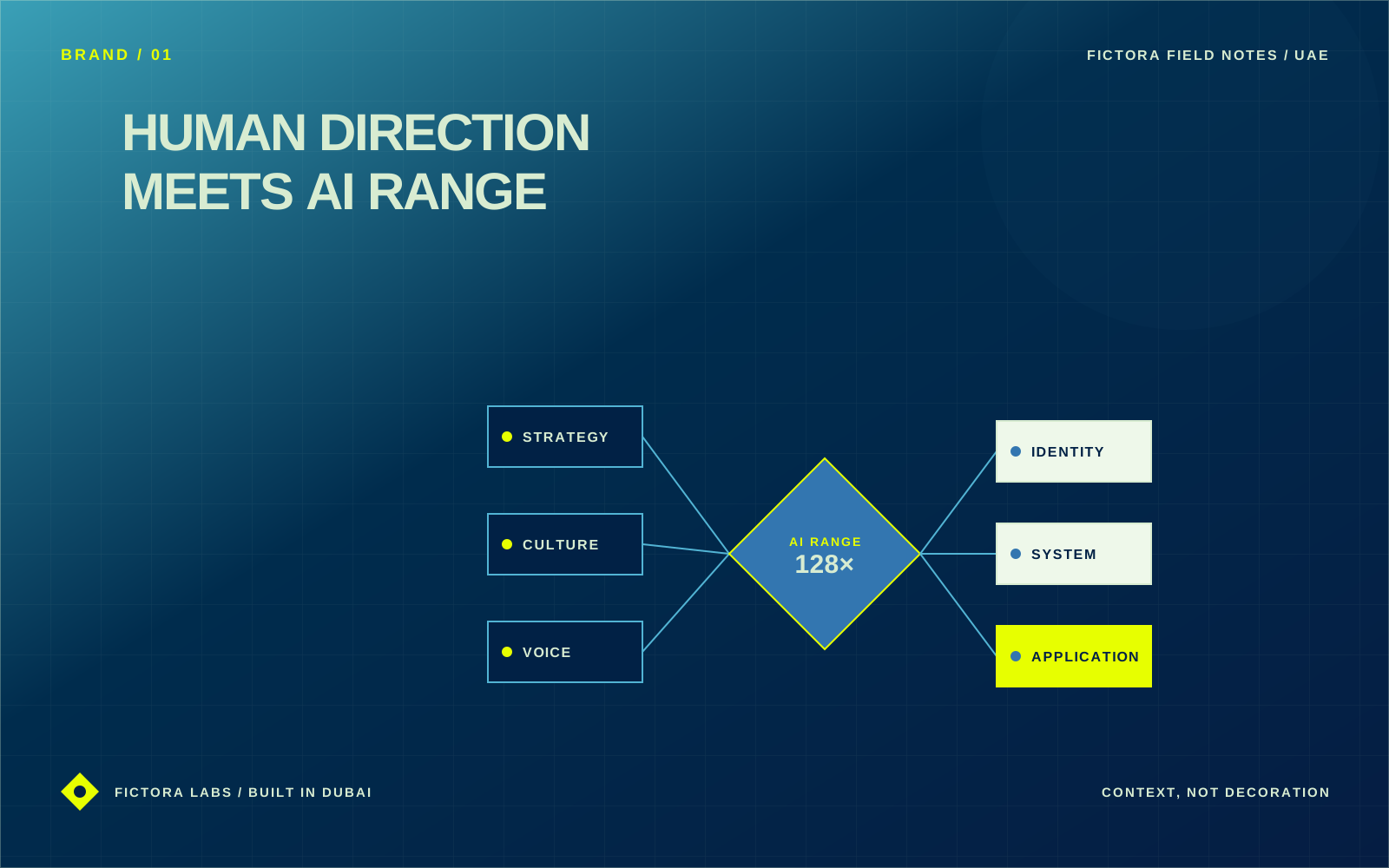
Artificial intelligence has changed the pace of brand identity design. Teams can now explore visual territories, compare directions, draft messaging and test applications in a fraction of the time those tasks once required. But speed is not the same as strategy, and an abundance of options is not the same as a distinctive brand.
The real shift is not that AI can “make a logo.” It is that AI can support more of the identity process—from research and concept exploration to production and governance—while giving designers more room to focus on judgment. Used carelessly, it produces familiar-looking brands assembled from the same visual averages. Used with a clear point of view, it helps a brand team examine more possibilities and build a stronger, more adaptable system.
AI changes the process, not the purpose of brand identity
A brand identity still has one central job: make the right business recognisable and meaningful to the right audience. The logo, typography, colour, imagery, motion and verbal style are tools for expressing that position consistently.
AI does not remove the need to decide what a company stands for, who it serves or why someone should choose it. It changes how quickly a team can move from those decisions to visible possibilities. That distinction matters. If the strategic brief is vague, AI simply generates vague work faster.
This is why a serious identity project should still begin with positioning, audience and competitive context. Our guide to professional branding for UAE businesses explains why a logo-only approach cannot carry the full commercial job of a brand.
Where AI creates real value in identity design
1. Research synthesis and pattern detection
Before designing, teams often review competitors, customer language, category conventions, cultural references and previous brand materials. AI can help organise this information, group repeated themes and expose contradictions in the brief. It can also turn long interview notes into a working set of hypotheses for a strategist to verify.
The important word is verify. AI can accelerate synthesis, but it should not be treated as a source of truth. The team must check the underlying evidence, separate customer language from model-generated assumptions and decide which patterns are strategically useful.
2. Broader concept exploration
Designers can use generative tools to explore mood, composition, symbolism, material, photography and motion before committing to one direction. This makes early exploration less dependent on the first few ideas that come to mind.
The best use is not asking for a finished identity. It is creating controlled experiments: What happens if the brand feels precise rather than playful? Can the same proposition work in a restrained editorial language and a more kinetic digital language? Which visual cues belong to the category, and which could become ownable?
These experiments help the designer make a better decision. They do not make the decision for the designer.
3. Faster system production
Once a direction is approved, AI-assisted tools can speed up repetitive production work. They can help generate image variations within an art direction, resize compositions, draft layout alternatives, suggest accessible colour pairings and create starting points for motion studies.
This is especially useful when an identity must work across a website, social content, proposals, WhatsApp assets, presentations and campaigns. A modern brand is not a static logo file; it is a system that has to survive many formats and many people using it.
4. Better brand governance
AI can also help after launch. A controlled assistant trained on approved guidelines can answer practical questions such as which logo variation to use, how much clear space is required, which tone suits a customer-service message or whether a draft follows the brand vocabulary.
This kind of application connects identity design with AI workflow automation. The value is not novelty. It is reducing avoidable inconsistency while keeping approved rules easy for a growing team to use.
What AI cannot responsibly decide
AI is strong at generating and recombining possibilities. Brand identity depends on choices that require accountability, context and taste. Those remain human responsibilities.
- Positioning: A model cannot decide which market your business should own or which customer tension is commercially worth solving.
- Cultural meaning: Symbols, colours, language and humour carry different meanings across communities. Local review is essential.
- Originality: A visually polished result can still resemble the category average or another brand too closely.
- Legal clearance: Generated marks and names still require appropriate trademark, licensing and usage-rights checks.
- Final craft: Typography, geometry, hierarchy, spacing and production details need deliberate refinement.
- Strategic courage: Distinctive brands often require rejecting the safest, most statistically familiar option.
The designer’s role therefore becomes more important, not less. Someone must set constraints, recognise what is generic, explain why one direction is right and convert an interesting image into a usable identity system.
A practical AI-assisted brand identity workflow
Step 1: Define the brand problem
Write the brief before opening a generative tool. Define the audience, business objective, competitive alternative, desired perception and behaviours the identity must support. “Make it modern” is not a useful problem. “Help a technical UAE service feel clear and trustworthy to non-technical decision-makers” is.
Step 2: Build an evidence base
Collect customer interviews, sales objections, search language, competitor examples and existing performance data. Label what is observed, what is inferred and what still needs validation. This prevents generated material from being mistaken for research.
Step 3: Create visual territories with constraints
Explore a small number of deliberately different territories. Give each one a strategic idea, not just a style label. Define what the territory should communicate, what it must avoid and where it needs to work. AI can then help broaden each territory without collapsing all of them into one aesthetic.
Step 4: Curate and design
Select promising elements based on the brief, then redraw, typeset, edit and combine them with professional design tools. Remove accidental details. Test the core mark at small sizes. Check contrast and accessibility. Confirm that the identity remains recognisable without relying on one hero image.
Step 5: Test the system in real situations
A brand identity should be judged in context: a mobile header, a sales deck, a social post, a bilingual announcement, a proposal cover and a customer message. A direction that only works on a moodboard is not finished.
Step 6: Document human and AI rules
Brand guidelines now need to cover more than logo placement. They should define approved prompts or image principles, prohibited styles, review responsibilities, source-file handling and when generated output requires legal or cultural review. This makes AI use repeatable without allowing it to dilute the identity.
Why the UAE context needs particular care
UAE brands often communicate across English and Arabic, serve audiences from several cultural backgrounds and move between premium physical environments and fast digital channels. An identity must remain coherent across those conditions.
AI can help teams explore bilingual layouts and a wider range of use cases, but it can also introduce errors that look convincing at first glance. Arabic typography should be reviewed by someone who understands the language and the script, not evaluated as a decorative shape. Cultural references should be checked for relevance rather than selected because they appear “local” to a model.
Businesses should also understand what they upload to third-party tools. Confidential strategy, unreleased product information, customer data and proprietary assets need appropriate controls. Convenience should not override privacy or ownership.
How to avoid the generic “AI brand” look
Generic output usually comes from generic inputs and weak curation. Repeated gradients, glossy symbols, abstract networks and over-polished mockups can make very different businesses look interchangeable.
A more distinctive result comes from constraints rooted in the company itself: a founder’s point of view, a product behaviour, a customer ritual, an unexpected cultural reference, a proprietary shape or a verbal idea that competitors cannot credibly claim. The team should also keep a record of source material and design decisions so the final identity has a traceable rationale.
The goal is not to hide that AI was used. The goal is to make sure the brand does not look as if nobody made a decision.
How to measure whether the new identity works
A successful identity is not measured by the number of concepts generated. Teams should evaluate whether customers recognise the brand, understand its offer, distinguish it from competitors and experience it consistently across touchpoints.
Useful measures can include direct brand feedback, message comprehension, consistency across channels, time required to produce approved assets and conversion behaviour before and after a coordinated rollout. These signals will not isolate design from every other business factor, but they are more meaningful than choosing the concept that receives the most subjective likes.
The future is human-directed, AI-accelerated branding
AI is becoming part of the identity-design toolkit in the same way digital layout, prototyping and motion tools did before it. Its lasting value will come from better exploration, faster production and more usable brand systems—not from replacing the strategic and creative judgment that makes a brand distinct.
At Fictora Labs, we use AI where it improves the work and human direction where the decision carries meaning. Our branding services in Dubai connect positioning, identity, digital application and practical guidelines into one system. If your business needs an identity built for real-world use rather than a folder of generated options, start a conversation with us.