


AI Chatbots / FICTORA FIELD NOTE
WhatsApp Chatbot Pricing and Implementation Costs in the UAE
Compare current Meta WhatsApp fees in AED, Zena AI plans, free-message rules, and the implementation costs UAE businesses should budget for.
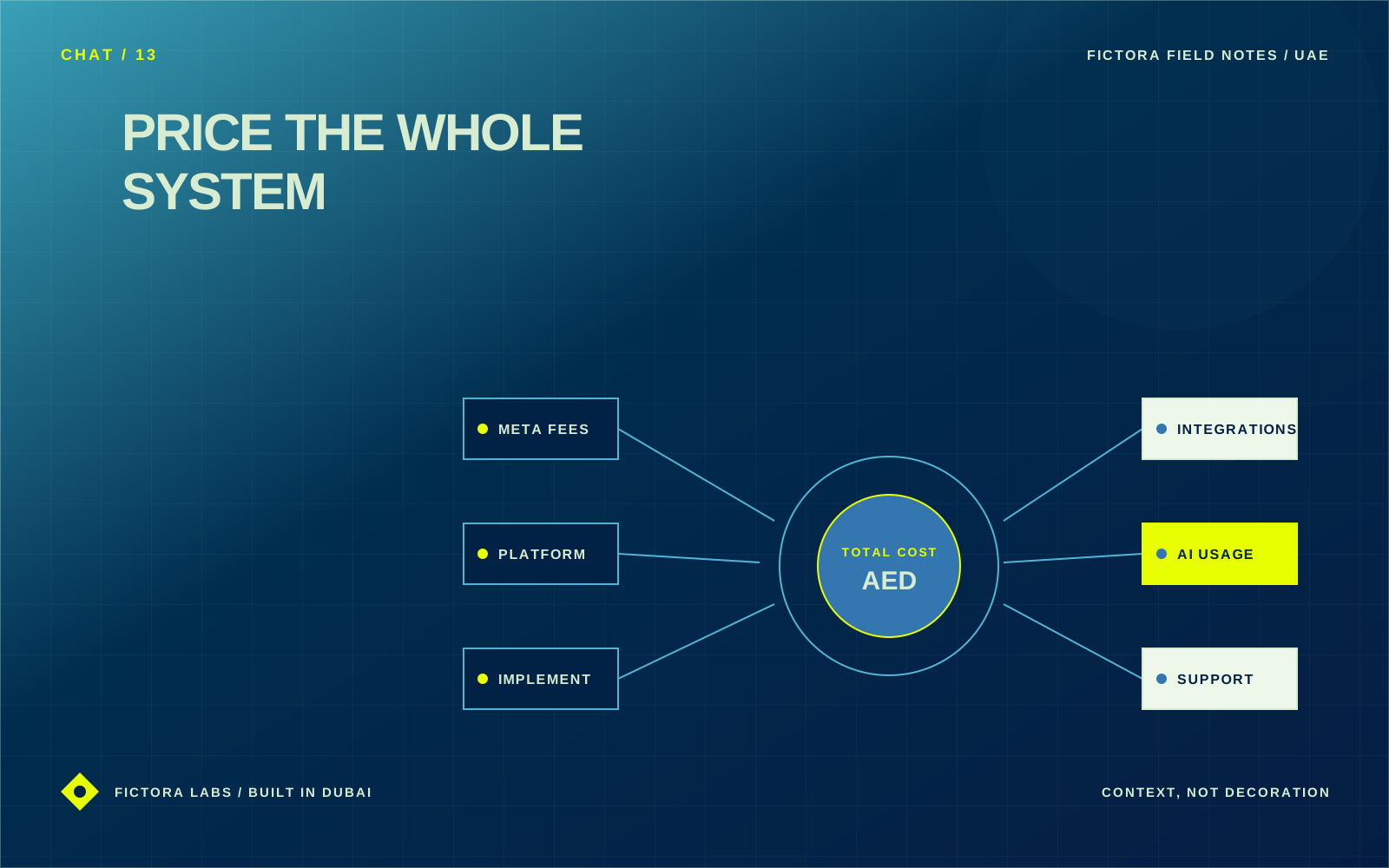
As of 6 September 2026, a WhatsApp chatbot in the UAE does not have one universal price. The total is a combination of Meta's message charges, any platform or technology-provider fees, the work required to design and integrate the system, and the ongoing cost of AI, hosting, support and optimisation. A quote that combines all of these into one unexplained monthly figure makes it difficult to compare providers or forecast what happens when usage grows.
This guide separates those costs and uses Meta's current published UAE rates in AED. It also checks Meta's announced rate-card update for 1 October 2026; the UAE is not among the markets listed for a change. For a productised route, Zena AI is Fictora Labs' live WhatsApp Business automation platform for UAE and GCC teams. For a bespoke deployment, our AI chatbot development service in Dubai covers discovery, conversation design, integrations and human handover as one operating system rather than an isolated chat widget.
The short answer: what should a UAE business budget for?
Budget for six separate layers. Only the first layer is a standard Meta rate; the others depend on the solution you choose and the complexity of your operation.
- Meta WhatsApp usage: charges for delivered messages, based primarily on the message category and the recipient's country code.
- Software or provider: a chatbot platform, inbox, technology provider or Solution Partner may charge a subscription, usage fee or service fee.
- Implementation: discovery, conversation design, template preparation, development, testing, launch and staff training.
- Integrations and data: CRM, scheduling, ecommerce, payment, ticketing, analytics, identity and reporting connections.
- AI and infrastructure: model usage, knowledge retrieval, hosting, databases, monitoring and security controls.
- Ongoing operations: support, content updates, quality review, template management, compliance and improvement.
A useful quote should show the one-time build separately from recurring fixed costs and variable usage. It should also state whether Meta's fees are passed through at cost, marked up, or included within an allowance.
Official WhatsApp message rates for UAE recipients
Meta determines the applicable market from the recipient's phone number country code, not simply from where the business is registered. The figures below therefore apply to messages delivered to a WhatsApp user with a UAE +971 number. They are Meta's published Cloud API rates in AED effective from 1 July 2026 and current on 6 September 2026.
Swipe the table horizontally to view all columns →
| Message type | Current UAE rate | Important condition |
|---|---|---|
| Marketing template | AED 0.1832 per delivered message | Charged even when sent during the 24-hour customer service window. |
| Utility template | AED 0.0576 per delivered message | Currently free when delivered inside an open 24-hour customer service window; otherwise charged. |
| Authentication template | AED 0.0576 per delivered message | Used for one-time passcodes and defined authentication flows. |
| Authentication-International template | AED 0.1872 per delivered message | Applies only when Meta's specific eligibility conditions are met; it is not the default rate for every UAE authentication message. |
| Service message | Free under the current model | A free-form reply sent while the 24-hour customer service window is open. |
At the current standard rate, 1,000 delivered UAE marketing messages cost AED 183.20 in Meta usage, while 1,000 billable utility or standard authentication messages cost AED 57.60. These amounts are before any volume discount, provider fee, implementation cost, AI usage or tax.
Meta offers volume tiers for eligible utility and authentication traffic. The discount is calculated by market and category across the business portfolio and resets monthly. For UAE recipients, utility tiers begin after 100,000 eligible messages in a month, while authentication and Authentication-International tiers begin after 300,000. Marketing messages do not receive volume-tier discounts. Most small and medium businesses should therefore forecast with the standard rate unless their measured traffic shows that a lower tier will apply.
Does anything change for UAE numbers on 1 October 2026?
Meta has announced a rate-card update effective 1 October 2026, but its current notice names Bangladesh, Iraq, Nepal, Sri Lanka, Kazakhstan, Kuwait, Morocco, Oman and Ukraine. The United Arab Emirates is not listed. As of 6 September 2026, Meta has not announced a new UAE rate or a change that would make standard service replies or in-window utility templates chargeable.
Budgeting implication: use the current UAE rates above rather than applying a speculative October increase. Recheck Meta's official rate card before launch because Meta can publish later updates under its pricing calendar.
How the 24-hour and 72-hour windows affect cost
When a user sends a message or starts a WhatsApp call, a 24-hour customer service window opens. Each new user message or call resets that window. While it is open, a business can send free-form service messages. Under the model current on 6 September 2026, utility templates sent in that window are also free, while marketing templates remain charged. Outside the window, the business can only initiate contact using an approved message template.
A separate 72-hour free entry-point window can begin when a person starts a conversation through a Click-to-WhatsApp advertisement or a Facebook Page call-to-action and the business responds within 24 hours. Once Meta delivers the response, the 72-hour window begins, and messages delivered during that period are free. The customer service window still operates separately. Meta's published 1 October 2026 notice does not announce a change to this free entry-point rule.
These windows should shape conversation design, but they should not be manipulated at the expense of the customer. Prompt, useful replies, explicit consent and sensible message frequency are better cost controls than sending unnecessary content to keep a conversation active.
A worked UAE cost example
Consider an illustrative month with 10,000 delivered messages to UAE numbers:
- 2,000 marketing templates;
- 3,000 billable utility templates outside the 24-hour window; and
- 5,000 service replies inside normal customer-service windows.
Using the rates current on 6 September 2026, Meta usage would be:
- 2,000 × AED 0.1832 = AED 366.40 for marketing;
- 3,000 × AED 0.0576 = AED 172.80 for utility; and
- 5,000 × AED 0 = AED 0 for service.
The resulting Meta usage total is AED 539.20.
Meta's announced 1 October 2026 update does not list a UAE rate change, so this traffic mix remains AED 539.20 on the information published as of 6 September. The example excludes volume discounts, Authentication-International rates, provider charges, AI usage, implementation, tax and any messages delivered during the free entry-point window. It is a forecasting example, not a quotation, and should be recalculated if Meta publishes a later UAE update.
The other costs in a WhatsApp chatbot project
Platform or technology-provider costs
A business can build on Meta's Cloud API or work through a technology provider, chatbot platform or Solution Partner. Depending on the arrangement, the provider may charge a monthly licence, per-user inbox fee, automation allowance, support retainer or markup on usage. In other arrangements, the business pays Meta directly for message usage and pays the provider only for software and services. There is no universal “BSP fee,” so ask the supplier to identify every recurring charge and who owns the underlying WhatsApp Business Account.
Conversation design and implementation
The visible chat flow is only one part of the build. A reliable launch also needs requirements mapping, opt-in design, message templates, error states, escalation rules, testing, analytics and team training. Generative AI adds knowledge-source preparation, retrieval rules, guardrails and evaluation. The cost depends more on the number of business processes and system decisions than on the number of buttons in a demo.
Integrations, AI and infrastructure
CRM updates, appointment availability, order status and qualified lead routing require secure connections to source systems. Costs can include API development, middleware, cloud hosting, databases, observability and model tokens. A chatbot that answers from approved documents also needs a process for keeping those documents current. For a practical explanation of retrieval, handover and rollout decisions, read our guide to AI chatbots for UAE businesses.
Ongoing operation
After launch, someone must review unanswered questions, failed integrations, template quality, opt-out handling and human response times. Meta and provider pricing can change. The knowledge base and approved answers will change too. Treat monitoring and improvement as an operating cost rather than assuming the initial workflow will remain accurate indefinitely.
Where Zena AI fits in this cost model
Zena AI is the productised option from Fictora Labs for businesses that want to run customer conversations on the official WhatsApp Business Platform without commissioning every layer from scratch. It combines multilingual AI replies by text or voice, a shared team inbox, lead capture, broadcasts, CRM and analytics. WhatsApp Coexistence onboarding can also let an eligible business keep using its existing WhatsApp Business app while adding Zena's team and automation layer.
In the formula above, Zena belongs in the platform or provider layer. Meta's delivered-message charges remain a separate variable cost, and AI model usage is separate too. Zena's published pricing states that it adds no markup to Meta message fees or bring-your-own AI provider usage, which makes those cost lines easier to audit.
As of 6 September 2026, Zena lists Founder 50 monthly rates of AED 199 for Starter, AED 499 for Growth and AED 899 for Business. Its published post-cohort prices are AED 249, AED 599 and AED 999 respectively. The product also offers a 14-day free trial without a credit card. Promotional availability and plan features can change, so confirm the current offer on the Zena AI pricing page before approving a budget.
Zena is the faster fit when the standard product covers the required inbox, AI, broadcast, lead and integration workflows. A custom Fictora Labs build is the better route when the project needs bespoke logic, deeper ERP or CRM connections, regulated approval steps, or channels beyond WhatsApp. See the Zena AI product and growth case study for how the platform connects conversations, teams and business systems.
Three levels of implementation complexity
The following tiers are useful for comparing scope. They are not Fictora Labs price bands, because a responsible price requires discovery of the actual systems, volumes and risk.
1. Foundation: one focused customer journey
A foundation build may answer a controlled set of questions, collect a lead, qualify a request and hand the conversation to a person. It usually has one language, a small approved knowledge set, basic analytics and limited integration. The main objective is proving that the journey is useful and measurable.
2. Operational: connected workflows
An operational build may read or write CRM records, create appointments or tickets, retrieve order information, support multiple teams and route conversations by intent. It needs stronger exception handling, access controls, reporting and deployment processes because an error can affect a live business record.
3. Multi-system or higher-control deployment
A more complex deployment may cover several brands or countries, multiple languages, regulated or sensitive data, large template volumes, role-based permissions and formal audit requirements. It can require security review, data-retention controls, resilience planning, human approval for selected actions and a staged rollout. Our guide to WhatsApp AI chatbots and UAE PDPL compliance outlines the questions that should be resolved before personal data enters the workflow.
A formula for estimating your real cost
Start with delivered-message data rather than the number of contacts in a database. Then calculate:
Monthly Meta usage = the sum of delivered messages in each market and category × the applicable rate, after valid free windows and volume tiers.
Monthly operating cost = Meta usage + platform/provider + AI and hosting + support and optimisation + a change budget.
First-year cost = one-time discovery, build, integration and launch + 12 months of operating cost.
Model at least three traffic scenarios: expected volume, a low case and a peak case. Separate UAE numbers from other markets because their rates may differ. If a provider bundles message usage, ask what happens when the allowance is exceeded and whether unused volume rolls over.
Compliance and ownership checklist before signing
- Opt-in: document how the customer consents to receive WhatsApp messages and how opt-out requests are enforced.
- Purpose: collect only the data needed for the declared journey, and define retention and deletion rules.
- Access: decide which staff and vendors can view conversations, exports, credentials and connected records.
- Human handover: state when automation must stop, who receives the case and the expected response time.
- Accuracy: define approved knowledge sources, review dates and a process for correcting wrong answers.
- Account ownership: confirm that your business owns or controls its Meta Business Portfolio, WhatsApp Business Account, phone number and templates.
- Data portability: establish what conversation, consent, contact, template and analytics data can be exported if the supplier changes.
- Cost transparency: separate Meta charges, software licences, implementation, AI usage, support and tax.
- Change management: identify who monitors Meta policy and pricing changes and how production updates are tested.
Frequently asked questions
Is the WhatsApp Business Platform free in the UAE?
Access to the platform is not the same as a zero-cost deployment. Meta charges for eligible delivered template messages, and a business may also pay for software, implementation, integrations, AI and support. Standard service replies, eligible utility templates inside the customer-service window and messages inside a free entry-point window can be free under Meta's current rules.
Does Meta charge per conversation or per message?
Meta's current model charges per delivered template message. Standard service messages inside an open customer-service window are free, and utility templates delivered inside that window are also free. Use the applicable rate card and window rules for the date on which messages will be delivered.
Do I have to use a WhatsApp Solution Partner?
Not in every architecture. Businesses can use the Cloud API, while technology providers and Solution Partners can add software, implementation and operational support. The right route depends on internal capability, integrations, governance and the level of support required.
Why can two providers quote very different amounts?
One quote may cover only access to an inbox or flow builder, while another includes discovery, custom integrations, AI evaluation, training, security, support and ongoing optimisation. Compare the scope, ownership model and variable charges line by line rather than comparing the headline monthly fee.
How can a business control WhatsApp chatbot costs?
Use accurate message categories, remove duplicate or unnecessary sends, design efficient customer journeys, monitor delivery and retry behaviour, and recheck Meta's pricing calendar before launch. Encourage genuine customer-initiated conversations where appropriate, but never use misleading prompts or ignore consent. Better routing and a clear human handover also prevent costly loops that do not resolve the customer's request.
Official sources and date of review
This guide was reviewed on 6 September 2026. Meta may revise pricing, eligibility rules and product behaviour, so verify the current documentation before approving a budget or launch.
- Meta developer documentation: WhatsApp Business Platform pricing
- WhatsApp Business Platform pricing and rate cards
- Meta developer documentation: customer service windows
- Meta developer documentation: free entry-point windows
- Meta developer documentation: template categorisation
- Meta developer documentation: Authentication-International rates
- Meta developer documentation: Solution Providers overview
- Meta developer documentation: obtaining user opt-in