


AI Chatbots / FICTORA FIELD NOTE
WhatsApp AI Chatbots and UAE PDPL Compliance: What Every Business Needs to Know in 2026
Deploying a WhatsApp chatbot in the UAE without PDPL compliance isn't just a legal risk, it's a business risk. Here's exactly what you need to build it right.
Most UAE businesses deploying WhatsApp chatbots in 2026 are doing it wrong.
Not technically — the bots work, messages get sent, leads get captured. The problem is what is happening to the data those conversations collect. Customer names, phone numbers, enquiry details, health information, financial data — all flowing through an automated system, often without a consent capture step, a data-retention policy, or a documented cross-border transfer basis.
The UAE Personal Data Protection Law (Federal Decree-Law No. 45 of 2021) is in force, and its executive regulations continue to expand the practical scope of enforcement. Businesses that built their WhatsApp automation on shaky foundations are now carrying compounding legal and reputational risk.
This guide covers what the PDPL actually requires from businesses running AI chatbots on WhatsApp, what unofficial tools are doing to your legal position, and how to build a compliant WhatsApp automation stack from the ground up.
What the UAE PDPL Requires From Automated Customer Communications
The UAE Personal Data Protection Law governs how businesses collect, store, process, and transfer personal data about individuals in the UAE. For businesses running AI chatbots on WhatsApp, the relevant obligations cluster around four areas:
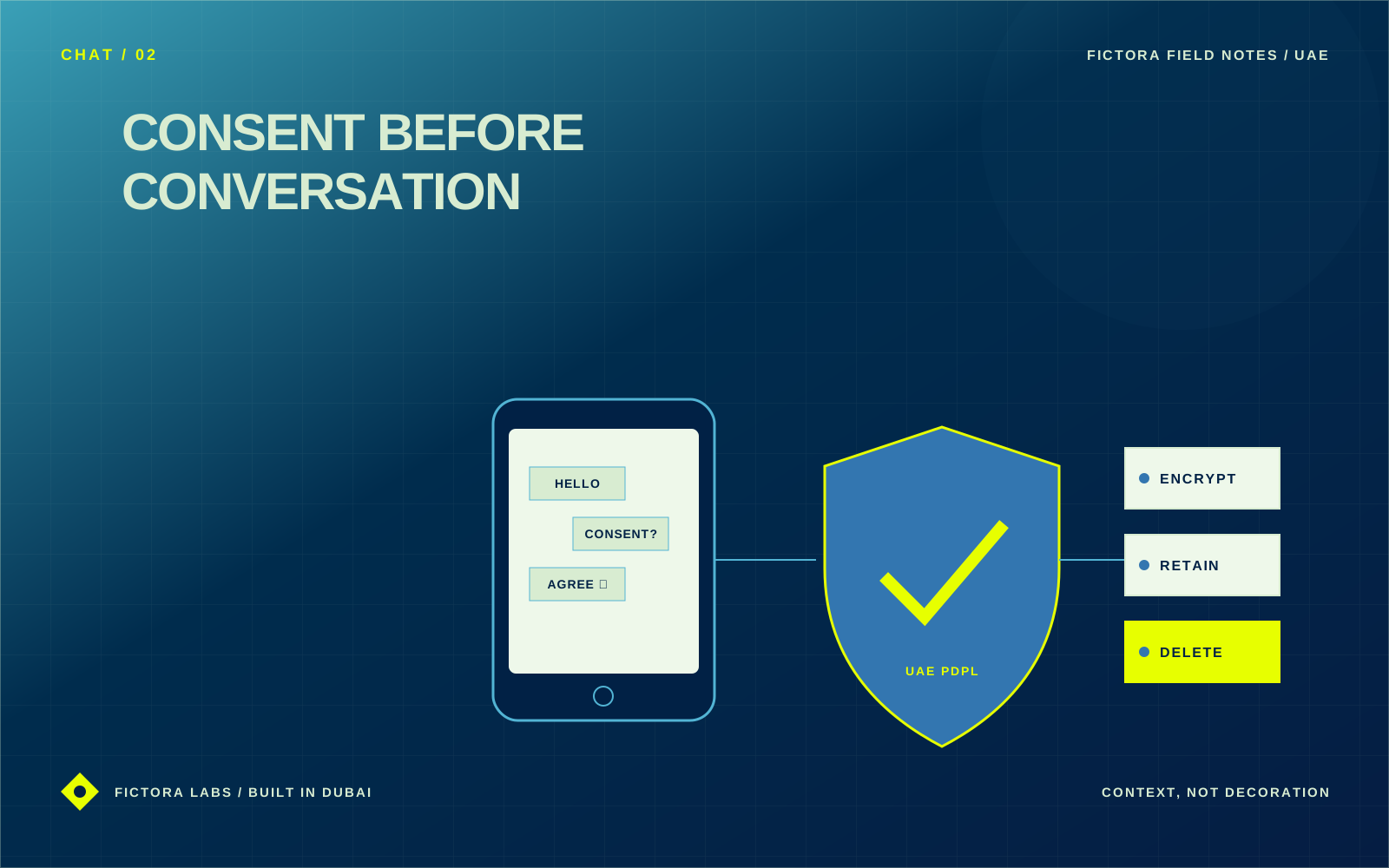
Consent. Personal data cannot be collected without the individual's knowledge and consent. In a WhatsApp chatbot context, this means the first message a customer receives must include a clear statement that their conversation data will be processed, what it will be used for, and how they can opt out.
Purpose limitation. Data collected for one purpose cannot be used for another without additional consent. A customer who contacts your chatbot about a property enquiry has not consented to a marketing broadcast. CRM contacts captured through chatbot conversations cannot be silently absorbed into a promotional list.
Data minimisation. You can only collect the data you actually need for the stated purpose. A chatbot that asks for date of birth, nationality, or income for a booking enquiry — when those fields are not required for the booking — is collecting more than the PDPL permits.
Security and cross-border transfer. Personal data must be stored and processed securely. Cross-border transfer is permitted where the destination has an adequate level of protection, a valid safeguard is in place (standard contractual clauses or equivalent), or an approved exception applies. Record the basis for each processor you use. Tools that route data through unspecified overseas servers create exposure precisely because no basis has been recorded.
The Official WhatsApp Business Platform vs Unofficial Tools
This is the most important decision any UAE business makes when deploying WhatsApp automation — and most businesses get it wrong because the unofficial options are cheaper and faster to set up.
Unofficial WhatsApp automation tools — sometimes called WhatsApp bulk senders, scrapers, or automation platforms — work by simulating a regular WhatsApp account at scale. They are not sanctioned by Meta, they violate WhatsApp's Business Terms, and they carry three compounding risks:
Risk 1 — Meta enforcement against the account. Meta actively detects unofficial automation of the WhatsApp app. Enforcement can include restricting the account, restricting the phone number, or terminating the business account. For a UAE business where WhatsApp is a primary customer channel, losing that number is a serious operational incident.
Risk 2 — PDPL exposure. Unofficial tools typically have no defined data-transfer basis, no documented encryption at rest, no audit logs, and no consent-management infrastructure. Every customer conversation processed through them is handled outside a legally defensible framework.
Risk 3 — No Business Platform features. Unofficial tools cannot send Meta-approved templates, cannot integrate with CRM systems through official APIs, and cannot access the delivery and quality analytics that the official Business Platform provides.
The official WhatsApp Business Platform — accessed through Meta-approved Business Solution Providers or directly — is the only supported foundation for WhatsApp automation. It provides end-to-end encrypted message delivery, Meta-reviewed message templates, conversation data that stays inside defined infrastructure, and eligibility to apply for Meta's verified-business badge (which requires meeting Meta's own criteria — the badge is not automatic on the API).
Every AI chatbot Fictora Labs builds for WhatsApp uses the official Meta Business Platform exclusively. Our Zena platform is built on it, with bilingual AI, a team inbox for human handoff, CRM integration, and a consent management layer configured for every tenant deployment.
Being on the official Business Platform is a prerequisite for PDPL alignment, not a substitute for it. The compliance work below still has to happen on top.
Building PDPL Compliance Into Your Chatbot Architecture
Compliance is not a layer you add on top of a chatbot after it is built — it has to be part of the architecture from the first message. What that looks like in practice:
Consent capture at conversation start
The first message the chatbot sends must include a clear, plain-language privacy notice — not a link to a policy buried three clicks deep, but an actual statement in the conversation itself. For UAE businesses, this notice needs to work in both English and Arabic.
A compliant opening looks like this:
"Hello! I'm [Business Name]'s virtual assistant. To help you today, I'll need to collect some basic information. Your data will be used only to assist with your enquiry and handled in line with UAE data protection law. Reply YES to continue, or STOP to end this conversation."
The customer's affirmative response is the consent event. Log it with a timestamp and store it as part of the conversation record.
Data minimisation in conversation flows
Map every piece of data the chatbot collects against the purpose it serves. To book a consultation you need: name, phone number, preferred date. You do not need nationality, date of birth, income level, or marital status unless those fields are directly relevant to the service being provided. Speculative data collection is a PDPL problem waiting to be found.
Encrypted data flows and role-based access
Data transfers between the chatbot, the CRM, and any connected systems must be encrypted in transit. Role-based access controls limit conversation data to authorised team members. In practice this means the chatbot's integration with HubSpot, Zoho, Salesforce, or Odoo uses vendor-supported connectors with credentials scoped to the minimum required permissions.
Audit logging
Every automated action the chatbot takes — message sent, data captured, CRM record created, escalation triggered — should be logged with a timestamp and a reference to the conversation that triggered it. This audit trail is your evidence of compliant processing if a regulator asks how a specific record ended up in a specific place.
Retention and deletion
The PDPL requires that personal data is not retained longer than necessary for its stated purpose. Your deployment needs a documented retention policy — how long conversation transcripts are stored, when CRM records are purged for inactive contacts, and how a customer can request deletion. When a request arrives, log it, delete across every workflow that touches the record, and confirm to the requester within the timeframe set by the law and its executive regulations.
Broadcast Messaging — the Highest-Risk Area for UAE Businesses
WhatsApp broadcast messaging — sending the same message to a large list of contacts — is where most UAE businesses accumulate their biggest PDPL exposure.
The common scenario: a business collects customer WhatsApp numbers from various sources — enquiry forms, walk-ins, business-card exchanges, chatbot conversations — and adds them all to a broadcast list. A promotional message goes out to two thousand contacts. The problem is that the vast majority of those contacts never consented to receive marketing on WhatsApp. Under PDPL, unsolicited marketing sent to individuals who have not explicitly opted in constitutes unlawful processing. The fact that the phone number was collected legitimately for a different purpose does not create consent for a different type of communication.
The compliant approach:
Every contact on a marketing broadcast list needs an explicit opt-in for marketing messages, separate from any consent given for service communications. This opt-in needs to be recorded with a timestamp. The opt-in message itself needs to clearly state that the customer is agreeing to receive promotional content and how they can opt back out.
Through the official WhatsApp Business Platform, broadcasts sent to UAE customers must use pre-approved message templates. Meta's template approval process includes review of message content — which provides quality control and also means non-compliant marketing language does not make it through in the first place.
What a Compliant WhatsApp Chatbot Stack Looks Like
For UAE businesses that want to deploy WhatsApp AI automation on a legally defensible foundation, the full stack looks like this:
Layer 1 — Official WhatsApp Business Platform. Connected through a Meta-approved Business Solution Provider (or directly) — the only supported channel for automated WhatsApp communications at scale.
Layer 2 — Consent management. Built into the first message of every conversation. Bilingual Arabic and English. Timestamped and logged. Separate opt-in flows for service communications and marketing communications.
Layer 3 — AI chatbot with data minimisation. RAG-based chatbot grounded on the tenant's knowledge base. Conversation flows designed to collect only the data required for the stated purpose. No speculative data collection.
Layer 4 — Encrypted CRM integration. Data transfers encrypted in transit. Role-based access on CRM. Field-level controls on sensitive data. Audit logging of every data action.
Layer 5 — Retention policy. Documented retention periods. Automated archiving of inactive conversations. Process for handling deletion requests within the timeframe the law and its executive regulations require.
Layer 6 — Monitoring and maintenance. Monthly review of conversation quality, data flows, and compliance posture. Policy changes from both Meta and the UAE data-protection authority tracked proactively.
This is the standard Fictora Labs applies to every AI chatbot deployment for UAE businesses. It is what separates automation that scales safely from automation that creates compounding legal exposure as the business grows.
Is Your Current WhatsApp Setup Compliant?
If you are running WhatsApp automation through an unofficial tool, without a consent-capture step, without a documented cross-border transfer basis, or without a retention policy — the answer is no.
The good news is that a compliant stack is not dramatically more expensive or complex than a non-compliant one. The difference is in the decisions made at the architecture stage — which is why it is worth getting right before you scale.
Talk to Fictora Labs about building a compliant WhatsApp AI chatbot for your UAE business →
For businesses that want the deployment fundamentals before compliance considerations come into play, see our What is an AI Chatbot guide. For pricing detail on running WhatsApp AI in the UAE, see the WhatsApp chatbot pricing guide.