


AI Chatbots / FICTORA FIELD NOTE
What is an AI Chatbot? Complete Guide for UAE Businesses in 2026
AI chatbots are reshaping how UAE businesses handle leads, bookings, and customer support. Here's everything you need to know before deploying one in 2026.
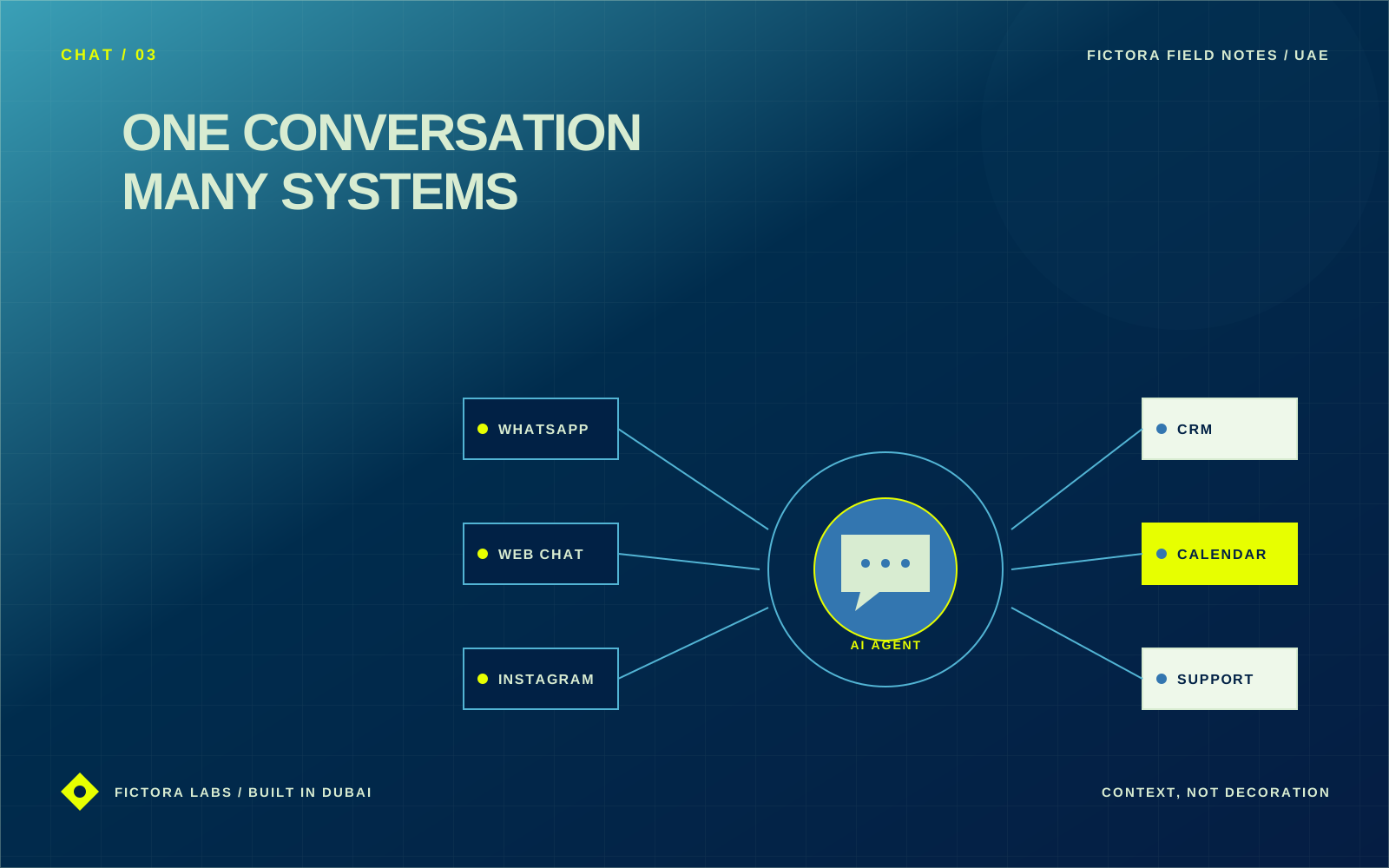
Your customers do not wait anymore. In the UAE, where WhatsApp is the primary business channel and service expectations run round the clock, a missed message at 10 pm is a lead your competitor picks up at 10:01 pm. The businesses winning in Dubai's digital economy in 2026 are not always the biggest — they are the ones that respond fastest, qualify leads automatically, and do not let enquiries fall through the cracks.
That is the job an AI chatbot does. This guide covers what a UAE business owner needs to know before deploying one — what it actually is, how the technology works, what it costs in time and money, and what separates a chatbot that converts from one that just answers questions.
What Is an AI Chatbot, Actually?
An AI chatbot is software that simulates human conversation — responding to messages, answering questions, and taking actions based on what a user says. That definition covers an enormous range of capability, from a basic rule-based FAQ bot to a fully retrieval-grounded agent that reasons over your knowledge base.
In 2026 there are three distinct generations of chatbot technology in use across UAE businesses:
Rule-based bots — the oldest generation. These follow decision trees: if the user says X, respond with Y. They are predictable and cheap but break the moment a user asks something outside the script. Most WhatsApp auto-reply setups are still rule-based.
LLM-powered chatbots — the current standard for serious deployments. These use large language models (such as GPT-4-class or Claude-class models) to understand intent and generate contextually appropriate responses. They handle unexpected questions, maintain conversation context, and read as genuinely human. The trade-off is that a model without grounding can drift; it needs guardrails.
RAG-based chatbots (Retrieval-Augmented Generation) — the most capable version for business use. These combine an LLM with your own knowledge base — FAQs, product catalogue, service policies, pricing documents. When a customer asks a question, the bot retrieves the relevant information from your verified data and generates a response grounded in it. Grounding reduces hallucination; it does not eliminate it, so a good system still routes uncertain cases to a human.
Every AI chatbot Fictora Labs builds for UAE businesses is RAG-based — because the UAE market has no patience for generic answers that do not match what is on your website.
Why UAE Businesses Are Deploying Chatbots in 2026
Five market conditions make AI chatbots particularly valuable in the UAE:
WhatsApp dominance. WhatsApp is the default business channel in the UAE, with penetration rates among the highest in the world (per DataReportal's Digital 2024 UAE report). Unlike email, messages sent on WhatsApp carry an expectation of fast response — often within minutes. An AI chatbot on the official WhatsApp Business Platform means that expectation is met automatically, at any hour.
Bilingual customer base. Customers speak English, Arabic, and often switch between both within a single conversation. A well-built AI chatbot handles this natively — responding in the language the customer uses, including Gulf dialect Arabic that generic translation tools consistently miss.
Round-the-clock business culture. Dubai's retail, real estate, and hospitality sectors operate across time zones with customers from Europe, Asia, and the Americas. The notion of "office hours" does not apply to lead enquiries. A chatbot is one of the most cost-effective ways to be genuinely always-on.
Labour cost. Multilingual customer-support headcount in the UAE is expensive. A well-configured AI chatbot absorbs a share of routine enquiries automatically, reducing pressure on the team; how large that share is depends on how well the knowledge base is written and how narrow the business scope is. Do not budget against a fixed percentage before you have measured on your own traffic.
UAE PDPL compliance. The UAE Personal Data Protection Law creates specific obligations around how businesses collect, store, and process customer data through automated systems. A properly built AI chatbot handles consent capture, data-transfer basis, and audit logging as part of its core architecture rather than as an afterthought.
The Fictora Labs Micro-SaaS Deployment Framework
Most AI integrations take months. Fictora Labs runs a four-stage deployment framework designed to compress that timeline for UAE businesses.
Discover — We map the customer conversation flows, identify the highest-volume query types, and define the exact use cases the chatbot will handle. This is the most important phase — a chatbot that is not scoped correctly will answer the wrong questions.
Design — We build the conversation architecture: decision flows, escalation triggers, tone guidelines, and knowledge-base structure. Arabic and English models are configured separately at this stage — not as a translation layer, but as independent linguistic frameworks.
Develop — The bot is built, grounded on the tenant's knowledge base, and integrated with target channels: WhatsApp Business Platform, website chat widget, Instagram DM, or voice. CRM connections (HubSpot, Zoho, Salesforce, Odoo) and calendar integrations are configured and tested.
Deploy and Optimise — The bot goes live. For the first thirty days we monitor conversation quality, identify failure patterns, and retrain the bot on real customer interactions. This post-launch optimisation is where most of the conversion improvement happens.
From brief to live agent: around three days for a Zena-based WhatsApp deployment, three to six weeks for a fully custom multi-channel build.
What a Chatbot Actually Does Day-to-Day
It is easy to describe AI chatbots in abstract terms. The operational reality across the industries deploying them most actively in Dubai:
Real estate. A buyer messages your agency WhatsApp at 9 pm asking about two-bedroom apartments in Business Bay under a specific budget. The chatbot responds within seconds, asks qualifying questions about their timeline and preferences, sends property details from your catalogue, and schedules a viewing for the following day. When your team arrives at the office, the viewing is on the calendar and the lead is in the CRM with the full conversation attached.
Healthcare clinics. A patient messages to book a dermatology consultation. The chatbot confirms availability, captures insurance details, sends appointment confirmation in Arabic and English, and triggers a reminder twenty-four hours before the appointment. Front-desk staff spend their time on patients already in the clinic.
E-commerce. A customer messages on WhatsApp during a sale asking about stock for three specific products. The chatbot checks live inventory, confirms availability, provides a direct purchase link, and follows up twenty-four hours later if the purchase was not completed. Cart abandonment stops being a spreadsheet exercise and becomes an automatic recovery flow.
Professional services. A prospect finds your consultancy through a search at 11 pm, visits your website, and starts a chat asking about your services and fees. The chatbot answers what it can from your knowledge base, captures their contact details, and books a discovery call for the following week. By the time your team is at their desks, the meeting is on the calendar.
How This Looks Inside a Real System — Zena
The operational descriptions above are what a Zena tenant sees in practice. Zena is Fictora Labs' live WhatsApp AI product; the flow below is the sequence the platform runs on every first message to a tenant business.
- Meta webhook delivers the incoming message. Zena identifies the tenant and loads that tenant's configured assistant and knowledge base.
- Consent and language detection. The opening reply names the business, states that responses may be automated, and continues in the language the customer used.
- Answer, qualify, or route. Covered questions are answered from the knowledge base. Real enquiries (pricing, booking, complaint) trigger the qualification fields the tenant asked for; the AI stops when it has what it needs.
- Human handoff when the situation requires it. A team inbox pings the tenant's agents with the full conversation context; the human takes over in the same WhatsApp thread without the customer having to repeat themselves.
- Record and follow-up. The conversation, the captured fields, and the outcome are logged against the customer's WhatsApp identity so that the next message resumes with context rather than starting over.
See the Zena case study for the full architecture. The lesson worth taking from it: a chatbot that only answers questions is a fraction of the value. The value multiplies when the chatbot is the front door of a wider automation stack — capture, qualification, routing, follow-up, and CRM logging all happen off a single conversation.
CRM and Tool Integration — Why It Matters
A chatbot that answers questions but does not connect to your business systems is a missed opportunity. The real value of a properly built AI chatbot is what happens after the conversation ends. Every interaction the chatbot handles can automatically:
- Create or update a CRM contact.
- Log the conversation with the full transcript.
- Tag the lead with qualification data.
- Trigger a follow-up email or WhatsApp sequence.
- Create a support ticket if the issue requires human attention.
- Book a calendar appointment with automatic confirmation.
Common integration targets in UAE deployments: HubSpot, Zoho, Salesforce, Odoo, Slack, and most calendar and ERP systems. For businesses running AI workflow automation across their operations, the chatbot becomes the front door of the entire automation stack — a customer interaction triggers a cascade of backend processes that previously required manual intervention at every step.
Zena vs Custom Build — Which Is Right for Your Business?
Fictora Labs offers two deployment paths for UAE businesses:
Zena is Fictora Labs' own WhatsApp AI product, purpose-built for UAE and GCC businesses. It provides a team inbox, AI-powered responses, lead capture, and human handoff on the official WhatsApp Business Platform. It is the right choice for businesses that want a proven WhatsApp AI layer live in days rather than weeks. See zena.fictoralabs.ae for the product detail and current pricing.
Custom chatbot builds are for businesses with more complex requirements: bespoke conversation flows, deep ERP or CRM integrations, multi-channel deployment across WhatsApp, website, Instagram, and voice, or specific regulatory requirements. These take three to six weeks and are scoped through the AI chatbot development service.
Both routes run on the official WhatsApp Business Platform. Neither uses unofficial WhatsApp tools that put your business number at risk under Meta's Business Terms.
Is an AI Chatbot Worth It for Your UAE Business?
If any of the following are true, the answer is yes:
- You receive more than twenty enquiries per week across WhatsApp, email, or your website.
- Your team spends more than two hours per day answering repetitive questions.
- You have leads that arrive outside business hours and are not followed up until the next day.
- You serve both Arabic and English customers and translation quality matters.
- You want a single system that captures, qualifies, and routes conversations, not just answers them.
The returns on a well-configured AI chatbot depend on the baseline: how many enquiries you receive, how much time the team currently spends on repetitive queries, and what percentage of after-hours leads are currently lost. Measure the baseline first; the numbers you get back are then attributable rather than projected.
Ready to Deploy an AI Chatbot for Your Business?
Talk to Fictora Labs about WhatsApp and AI chatbot development in Dubai →
Fictora Labs is a DFHQ-recognised AI chatbot development company based in Dubai. We also provide SEO and AEO services to ensure your business is visible to the customers your chatbot will be converting.