


Automation / FICTORA FIELD NOTE
How to Automate Your Back-Office in Dubai (2026 Guide)
Still managing approvals, invoices, and onboarding manually? Here's how Dubai SMEs are automating their back-office in 2026 — and what to automate first.
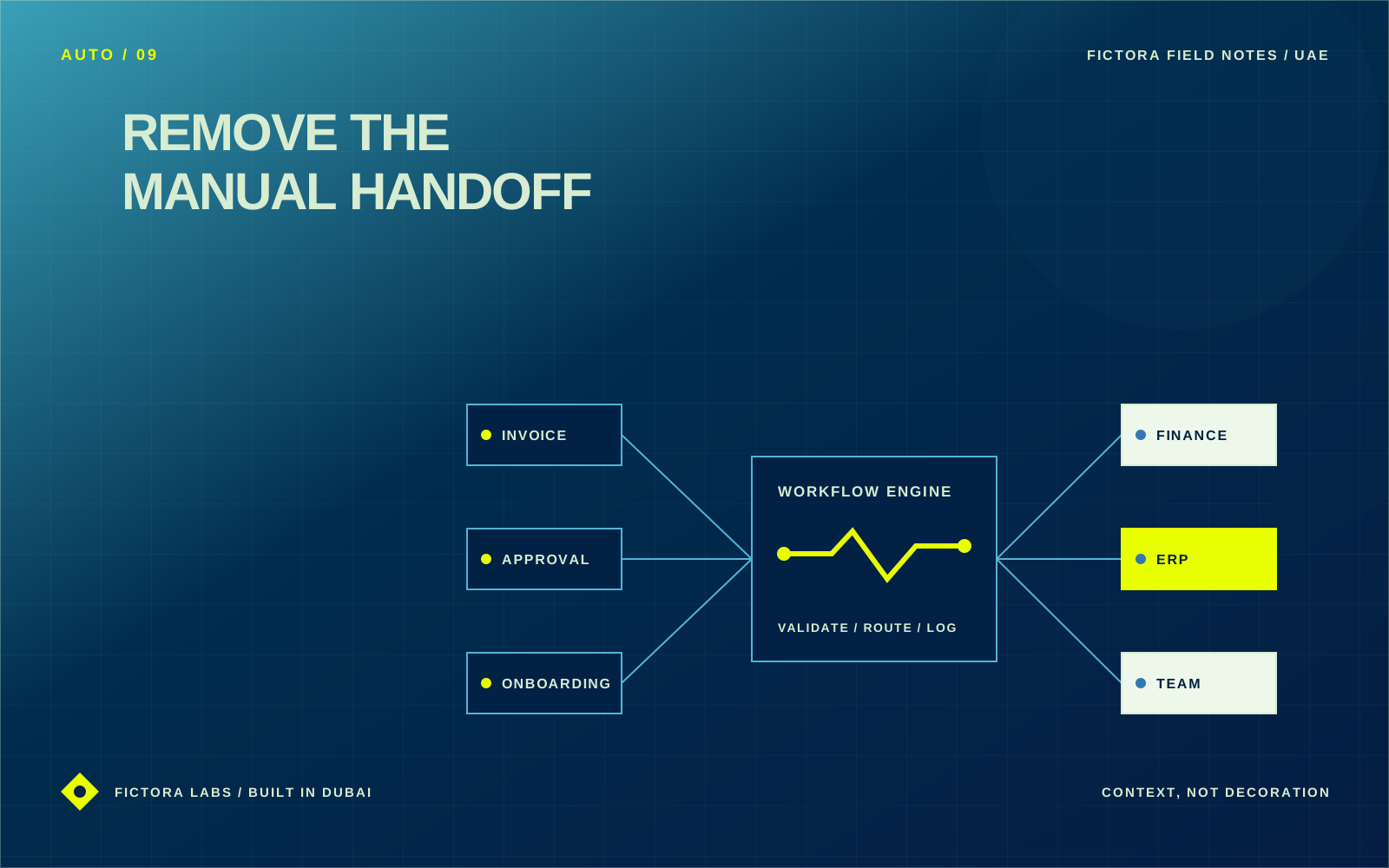
If your team is spending Monday morning catching up on Friday's paperwork, you have a back-office problem.
Most Dubai SMEs do not lack talent — they lack systems. The same invoice gets touched by three people. Approvals sit in email chains for days. New employee onboarding is a checklist someone manually ticks off in a spreadsheet. KYC documents get chased over WhatsApp. None of this is inevitable; it is what happens when you scale a business without scaling the systems alongside it.
This guide breaks down what back-office automation means for UAE businesses in 2026, which processes to automate first, and how to start without disrupting what is already working.
What Is Back-Office Automation?
Back-office automation — formally called Business Process Automation (BPA) — means using software to handle the repetitive, rules-based administrative tasks that currently require manual input from your team.
It is not about replacing people. It is about redirecting them. When a system handles invoice matching, document collection, or approval routing automatically, your finance manager is free to analyse the numbers instead of entering them; your HR team focuses on hiring instead of onboarding admin. The principle is simple: if a task follows a predictable set of rules, a machine can do it faster and with fewer errors than a human.
The Hidden Cost of Manual Back-Office Work
The cost is not just time — it is compounding errors and missed opportunities. Rather than quote an industry-average percentage of the working day lost to manual work, the honest exercise is to measure it inside your own operation: ask each team member to log one week of what they actually do. The result is almost always more repetitive-task time than management estimates.
Consider what happens when:
- A lead submits an enquiry on Friday evening and does not hear back until Sunday.
- An invoice gets processed three days late because the approver was travelling.
- A new client's KYC documents get manually re-entered into three separate systems.
- A monthly report takes half a day to assemble from four different tools.
Each of these has a direct cost — in time, in errors, and in the impression it leaves on clients and partners.
The Five Back-Office Processes Dubai SMEs Usually Automate First
Not everything should be automated at once. The highest-value starting point is usually the process that is highest in volume, most repetitive, and most prone to human error. The five that consistently deliver the fastest return for UAE SMEs:
- Invoice processing and approval workflows
- KYC and document collection
- HR onboarding
- Contract processing
- Reporting and data consolidation
1. Invoice Processing and Approval Workflows
Manual invoice handling is one of the most common pain points for trading, logistics, and professional services businesses in Dubai. Automation pulls invoice data from email or supplier portals, matches it against purchase orders, routes it to the correct approver, and posts to accounting once approved. Errors caused by manual re-entry disappear; approval SLA becomes something you can actually measure.
2. KYC and Document Collection
For financial services, real estate, and any business that onboards clients with compliance requirements, KYC document collection is time-consuming and repetitive. Automated workflows send collection requests, chase missing documents, validate completeness, and log submissions in the CRM — while keeping the audit trail intact for regulatory review.
3. HR Onboarding
New employee onboarding involves the same sequence of tasks every single time — contracts, system access, equipment requests, introductory emails, training schedules. All of it can be automated from the moment an offer is accepted. The new hire gets a structured, professional experience; the HR team stops doing the same checklist over and over.
4. Contract Processing
Generating, sending, tracking, and chasing contracts is another high-volume, low-creativity task. Automation handles template population, send sequences, reminder follow-ups, and status updates in the CRM automatically — so business development focuses on negotiating rather than chasing signatures.
5. Reporting and Data Consolidation
Weekly and monthly reports that currently require manually pulling data from multiple systems — CRM, ERP, marketing platform, finance tools — can be consolidated into live dashboards that update automatically. Tools like Looker Studio and Power BI, connected via automation platforms, replace the "someone rebuilds the deck every Monday" ritual.
What About Older Software That Cannot Integrate?
Many UAE SMEs still rely on legacy systems — older accounting software, custom inventory tools, or ERP platforms that predate modern API support. These create data silos that automation cannot always bridge through standard integrations.
The solution is Robotic Process Automation (RPA). RPA bots simulate user actions — logging into older software, extracting data, and transferring it into modern systems — without requiring any changes to the legacy platform itself. It is the equivalent of a fast, accurate operator who does not take a day off. The key advantage of RPA is that it works within your existing setup: you do not need to replace or upgrade legacy systems, and the bot bridges them to the modern stack while your existing software investments stay useful.
RPA has trade-offs — it is brittle when the legacy UI changes, and it needs monitoring — but for genuinely stuck integrations it is often the pragmatic route.
How to Start: The Three-Step Approach
The biggest mistake businesses make with automation is trying to automate everything at once. Start small, prove the value, then expand.
Step 1 — Pick one high-volume process. Choose the task the team does most often that follows the same steps every time. Invoice approval, document collection, or weekly reporting are usually strong starting points for UAE SMEs.
Step 2 — Map the current process in full. Write down every step, every decision point, and every system involved. Who touches it? When? What triggers the next step? This mapping exercise often reveals inefficiencies you did not know existed, and it makes the automation build significantly faster.
Step 3 — Build, test, and go live on that one workflow. Resist the temptation to scope more until the first workflow is live and running cleanly. A single well-built automation earning its keep builds the internal confidence and budget to expand further.
UAE Compliance Considerations
Any automation that processes customer data in the UAE needs to be built with the UAE Personal Data Protection Law (Federal Decree-Law No. 45 of 2021) in mind. In practice this means consent capture where applicable, PII masking for sensitive fields, a documented cross-border transfer basis for any processor outside the UAE, and full audit trails for every automated decision.
This is not optional — UAE businesses remain legally accountable for how customer data is handled, even when third-party automation tools are processing it. Every workflow Fictora Labs builds includes these compliance checks as standard.
What Tools Do UAE Businesses Use?
The most common platforms used in UAE SME automation projects in 2026:
- n8n — open-source workflow automation, highly customisable, preferred for complex multi-step workflows and businesses that want to own their infrastructure.
- Make.com — visual workflow builder, good for mid-complexity integrations across common SaaS tools.
- Zoho Flow / Zoho Creator — strong fit for businesses already inside the Zoho ecosystem.
- Zapier — the widest connector library; good for simple, low-volume workflows where speed to deploy matters more than depth.
The right tool depends on the existing stack, the team's technical comfort, and the complexity of the workflows being built. There is no universal answer — which is why a proper audit before build is essential.
What Comes After Back-Office Automation?
Once the back-office runs automatically, the next layer is customer-facing automation — lead qualification, sales funnel follow-ups, WhatsApp AI support, and CRM + ERP integration. Each layer compounds the value of the previous one. The businesses that move fastest in Dubai's market in 2026 are the ones with the most efficient systems behind their teams, not the ones with the biggest teams.
Ready to Automate Your Back-Office?
Fictora Labs helps UAE SMEs identify, scope, and build automation systems that are live within weeks. Every project includes compliance checks, team training, and thirty-day post-launch optimisation.
Talk to us about your workflows →
Fictora Labs is a DFHQ-recognised AI automation and digital marketing agency based in Dubai, UAE. Our AI workflow automation service is purpose-built for UAE and GCC SMEs.