


Automation / FICTORA FIELD NOTE
How to Choose the Right CRM for UAE Businesses (2026 Guide)
Choosing a CRM in the UAE in 2026 means more than picking software. Here's what Dubai SMEs need to know — from PDPL compliance to Arabic support and ERP integration.
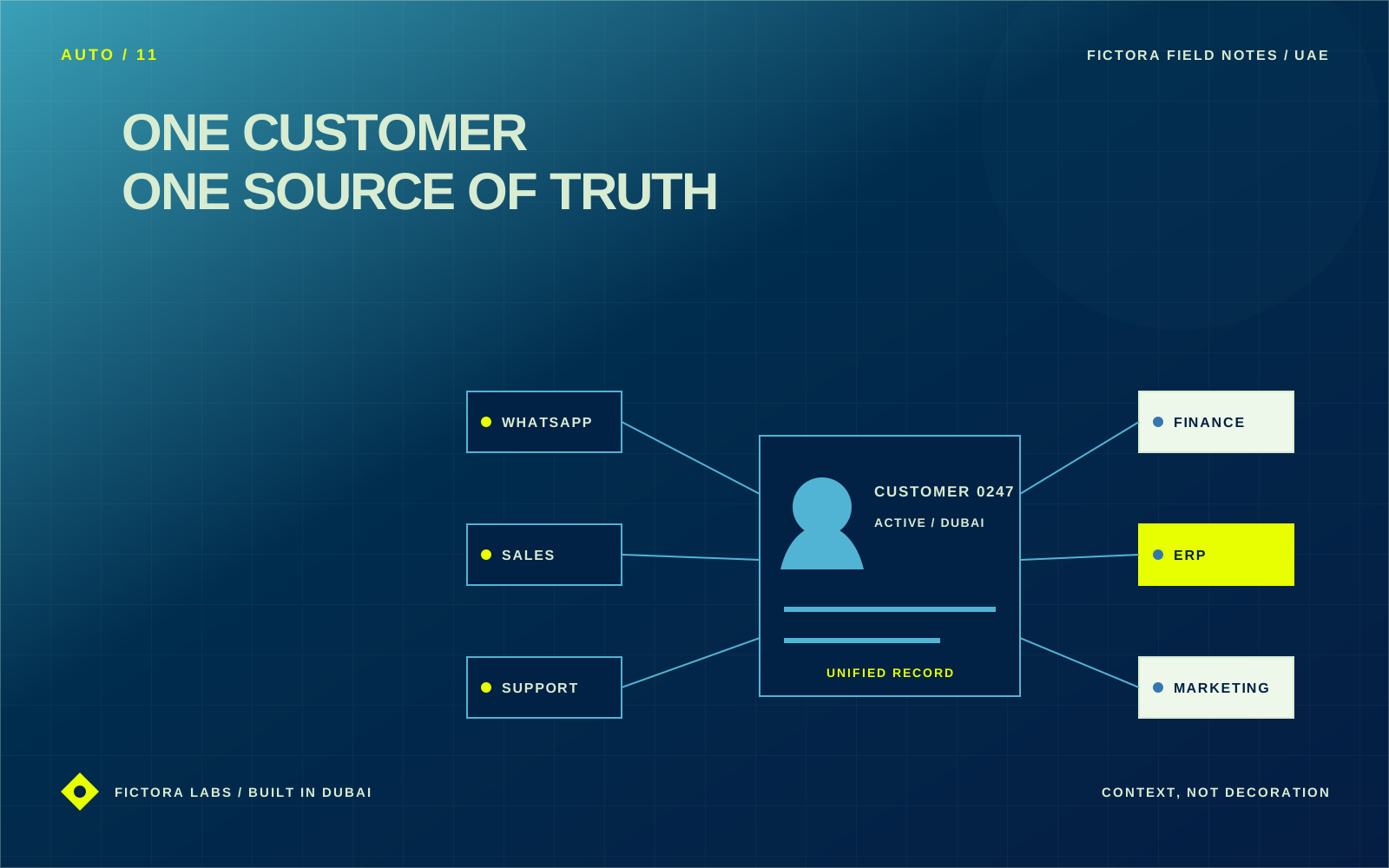
Choosing a CRM in the UAE is not the same as choosing one anywhere else. The interface needs to work in Arabic and English, revenue and pipeline values need to be legible in AED, and the platform has to sit cleanly under the UAE Personal Data Protection Law (Federal Decree-Law No. 45 of 2021). It also has to connect to WhatsApp, because in the UAE, that is where most customer conversations actually happen.
This guide is a decision framework, not a ranking. Below are the requirements that matter locally, a neutral comparison of ten CRMs UAE SMEs regularly evaluate in 2026, and the implementation patterns that decide whether a CRM sticks or gets abandoned after six months.
Start With the Business Goal, Not the Feature List
The most common CRM mistake is starting with a software comparison instead of a business objective. A CRM that fits a Dubai real-estate agency is the wrong choice for a Sharjah trading company. Before opening a single product demo, name the top two things the CRM has to fix:
- Lead conversion — if leads fall through the cracks, prioritise pipeline visibility, automated follow-up, and WhatsApp integration.
- Customer retention — if the priority is nurturing existing accounts, prioritise contact history depth, renewal tracking, and lifecycle automation.
- Operational efficiency — if the win is eliminating manual data entry between CRM, ERP, and accounting, then integration depth matters more than front-end features.
- Team collaboration — if multiple departments share customer context, prioritise role-based permissions, shared pipelines, and cross-team activity logs.
Writing those two objectives down before any demo eliminates most of the options on any comparison list. It also gives every vendor conversation the same benchmark.
UAE-Specific Requirements That Narrow the Field
Five requirements are non-negotiable for a UAE business and, in practice, remove otherwise capable global CRMs from serious consideration:
- Arabic and English support — right-to-left rendering has to work natively across UI, email templates, and reports. Unicode support is not the same as functional Arabic UX; test with an Arabic user before signing.
- AED and multi-currency — pipeline value, quotes, and reporting need to be legible in AED. If the business trades across the GCC, check that SAR, QAR, KWD and OMR handling is native rather than manual.
- UAE PDPL alignment — a data-processing agreement, consent capture, access and erasure workflow, and a documented cross-border transfer basis for any region the data crosses. Data residency is a plus, not a prerequisite; the legal basis is what matters.
- WhatsApp Business Platform integration — either native, or via a supported middleware (n8n, Make, or the vendor's own connector). A CRM that cannot log WhatsApp conversations leaves the biggest UAE channel outside the customer record.
- VAT handling — UAE VAT is 5%. Quote and invoice features should apply it cleanly, or the CRM should integrate with an accounting tool that does.
Ten CRMs UAE SMEs Regularly Evaluate — Neutral Comparison
The table below is intentionally neutral. It compares platforms on the dimensions that matter locally rather than declaring a winner; the right choice depends on which of the requirements above are most load-bearing for your business.
| CRM | Positioning | Pricing model | Arabic UI | WhatsApp integration | Multi-currency | Best fit |
|---|---|---|---|---|---|---|
| HubSpot | Inbound marketing + sales suite | Free tier; paid Starter, Professional, Enterprise | Functional | Via official WhatsApp Business Platform connector | Native | Inbound-led teams that want marketing and CRM in one system |
| Zoho CRM | Full Zoho ecosystem (Books, Inventory, Desk, Flow) | Free tier for small teams; per-user paid tiers | Strong | Native + Zoho Marketing Automation | Native | SMEs that want one vendor across sales, accounting and support |
| Salesforce Starter / Sales Cloud | Enterprise-grade platform, extensive AppExchange | Starter is per-user monthly; Sales Cloud tiers rise steeply | Functional | Via AppExchange or middleware | Native | Teams scaling past 50 users or with complex multi-team sales |
| Pipedrive | Visual pipeline for pure sales teams | Per-user, three main tiers | Limited | Via marketplace apps or middleware | Native | Small sales teams that want a clean pipeline and nothing else |
| Odoo CRM | Module in the Odoo ERP suite | Free for a single app; per-user for full suite | Strong | Via community modules or middleware | Native | Product / trading businesses already running Odoo for inventory or accounting |
| Freshsales (Freshworks) | Sales + support in the Freshworks stack | Free tier; per-user paid tiers | Functional | Native WhatsApp connector | Native | Teams already on Freshdesk who want an aligned CRM |
| Monday CRM | Work-management first, CRM as a template | Per-user, minimum seat counts | Functional | Via marketplace apps or middleware | Native | Cross-functional teams that already run projects on Monday |
| Bitrix24 | CRM + intranet + collaboration in one platform | Free tier for small teams; flat-fee paid plans | Strong | Native WhatsApp connector | Native | Teams that want CRM, tasks, chat, and telephony bundled |
| Notion (as CRM) | General-purpose workspace configured as a CRM database | Free personal; paid team and business tiers | Functional (workspace-level) | Via middleware only (Zapier, n8n) | Formula-based, not native | Small teams already living in Notion; low-volume, high-context sales |
| Airtable (as CRM) | Spreadsheet-database hybrid configured as a CRM | Free tier; paid team, business, enterprise | Functional | Via middleware only | Formula-based, not native | Teams that need flexible schema and views more than pipeline automation |
Two honest observations about the data-residency question: most global vendors host in one of the hyperscaler regions (AWS or Azure), and only some offer a UAE region for enterprise contracts. For most SMEs, the right question is not "is my data in the UAE" but "do I have a data-processing agreement and a valid transfer basis under PDPL for wherever it lives" — a decision the CRM's contract makes, not the marketing page.
CRM Without Integration Is Just a Contact List
The most important question to ask about any CRM is not what it does on its own — it is what it connects to. A CRM that sits in isolation from the ERP, the accounting system, WhatsApp, and the marketing tools is a slightly organised address book. The value multiplies when the CRM becomes the hub every other system feeds and pulls from.
Four integrations that consistently move the needle for UAE SMEs:
- CRM ↔ ERP (Odoo, SAP, Microsoft Dynamics) — a closed deal should create a customer record, trigger invoicing, and update inventory automatically. This eliminates the manual handoff between sales and operations.
- CRM ↔ Accounting (QuickBooks, Xero, Zoho Books) — payment status should flow back into the CRM so sales sees outstanding invoices without switching systems.
- CRM ↔ WhatsApp Business Platform — every conversation logged to the customer record; new contacts created automatically; lead status updated by tags. Where the CRM has no native connector, connect it through middleware or through a purpose-built WhatsApp platform. Fictora Labs uses Zena for the WhatsApp layer and pushes structured conversation data into whichever CRM the tenant runs.
- CRM ↔ Marketing automation — lead scores, campaign engagement, and email opens should feed the sales view, so the team knows which leads are warm and why.
Building these connections rarely requires replacing the existing stack. It usually requires connecting what is already there — which is exactly the work the AI workflow automation service does end to end.
Implementation — Where Most UAE CRM Projects Fail
The CRM software is rarely the reason a deployment fails. The implementation is. The failure patterns repeat:
- No clear owner. If no one in the business is responsible for maintaining the CRM, it degrades within months. Contacts become outdated, pipelines are unmaintained, and the team quietly reverts to spreadsheets.
- Over-customisation before adoption. Building a complex, highly customised CRM before the team is using the basics guarantees low adoption. Start simple, prove value, then customise.
- No data migration plan. Existing customer data lives in spreadsheets, old systems, and WhatsApp threads. Without a plan to import and clean it before go-live, the CRM launches empty and no one uses it.
- Training treated as optional. A CRM the team does not know how to use properly is worse than no CRM. Budget for role-specific training, not a thirty-minute walkthrough.
- Measuring the wrong things early. In the first three months, the metric is adoption. After that, pipeline accuracy. ROI metrics come later, once data quality is high enough to trust.
A Simple Decision Framework
If none of the requirements above make the choice obvious, this shortlist maps common UAE-SME situations to a sensible starting evaluation:
- Early-stage, budget-conscious → start with the free tier of HubSpot, Zoho CRM, or Bitrix24.
- Already on the Zoho ecosystem (Books, Inventory, Desk) → Zoho CRM.
- Already on Odoo for operations → Odoo CRM.
- Fast-growing sales team (5–20 reps) that needs pipeline discipline → Pipedrive or HubSpot Professional.
- Complex, multi-department, 50+ users → Salesforce Sales Cloud (with a dedicated admin).
- Team already lives in a workspace tool → Notion or Airtable as CRM, with middleware for WhatsApp and email.
- WhatsApp-first customer base with no CRM yet → deploy Zena for the WhatsApp layer first, then bring in the CRM that matches the operational goal above.
None of these is a permanent verdict. A CRM decision is easier to re-evaluate in year two than to force through in year one; get the first year right, then let the operational reality tell you what to keep or replace.
Ready to Choose and Deploy the Right CRM?
Fictora Labs helps UAE SMEs evaluate, deploy, and integrate CRMs end to end — from selection through data migration, WhatsApp integration, and PDPL-aligned workflow design.
Talk to us about your CRM setup →
Fictora Labs is a DFHQ-recognised AI automation and digital marketing agency based in Dubai, UAE. Zena is our live WhatsApp AI product for tenant businesses that want a purpose-built customer-messaging layer sitting alongside whichever CRM they operate.