


Automation / FICTORA FIELD NOTE
Is AI Automation Worth It for UAE SMEs? ROI Breakdown 2026
How much does AI automation actually cost in Dubai — and what do UAE SMEs get back? A practical ROI breakdown for 2026 with real numbers and timelines.
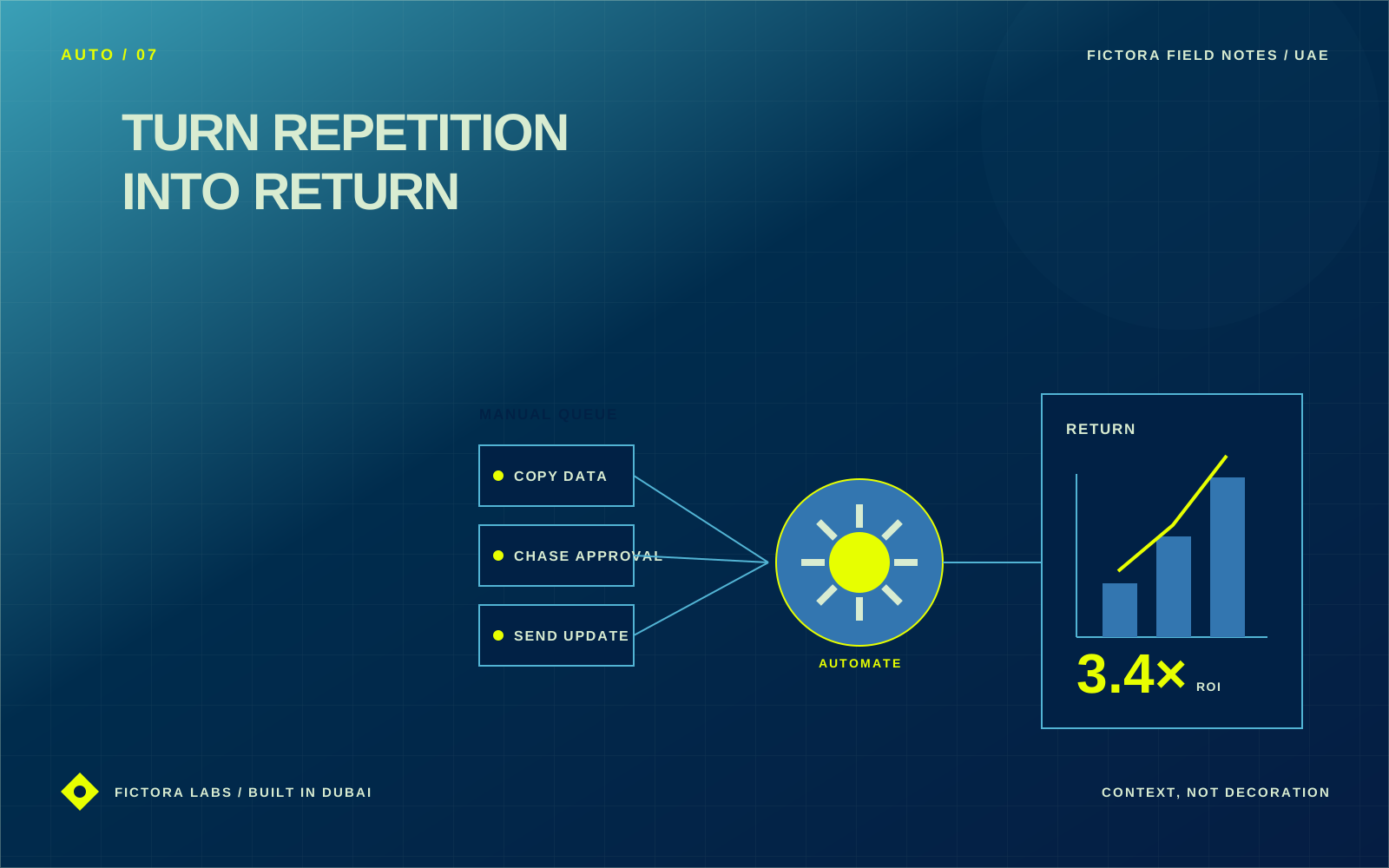
Every UAE business owner considering automation asks the same question: is it actually worth it?
It is a fair question. Automation projects require upfront investment — in time, in setup, and in cost. Before committing, you want to know what you are getting back, how quickly, and whether it makes sense at your size. This piece is a practical, honest framework for evaluating that question. Where a specific number appears below, it is either a principle framed as a range or something you can measure on your own operation; we have deliberately removed the invented benchmarks that were previously used to make the case.
The Real Cost of Not Automating
Before talking about the cost of automation, it is worth quantifying what manual processes are already costing you. The honest way to do that is to measure your own team, because industry-average percentages do not describe your business. Two questions to ask this week:
- How many hours per person per week go to repetitive, rules-based tasks — data entry, report compilation, approval chasing, document processing, manual follow-up? A one-week time-log across the team is enough to answer this.
- What is a leaked lead worth to your business? Multiply the average lead value by the leakage rate on your slowest response window and you have the annual cost of "we will follow up on Monday".
Beyond salary and leaked-lead costs, manual processes carry hidden costs that rarely appear on a spreadsheet:
- Error costs — manual data entry errors create downstream problems that take time and money to fix. A mis-entered customer record can corrupt CRM data, trigger wrong invoices, or cause compliance issues.
- Speed costs — a lead that waits hours for a response converts at a fraction of the rate of one that hears back instantly. In Dubai's market, slow response is direct revenue loss.
- Scaling costs — without automation, the only way to handle more volume is to hire more people. Automation lets you handle growing volume without proportional headcount growth.
The question is not whether automation has an ROI. It is whether the ROI is large enough, and soon enough, to justify acting now rather than later — and that answer depends on the numbers above, not on averages.
What AI Automation Actually Costs
Automation projects vary widely in scope, so a single price tag would be misleading. What we can list honestly is what you are paying for, so a quote you receive is easier to interrogate:
- Discovery and design. A structured mapping of the current process, the target state, and the workflows to build.
- Build and integration. The actual workflow build inside n8n, Make, or the platform you choose, plus connections to your CRM, WhatsApp Business Platform, calendar, ERP, or accounting system.
- Testing. End-to-end runs with real data, including failure-mode tests (what happens when the CRM is down, what happens when the notification fails).
- Team training. Not a thirty-minute walkthrough — role-specific training that shows each team member how the automation fits their daily work.
- Ongoing support and iteration. Monthly review, workflow adjustments, and adding the next workflow once the current one is stable.
A common mistake UAE SMEs make is pricing automation on software licence cost alone and underestimating the implementation and maintenance layers. A cheap platform with no build partner and no operational owner is almost always more expensive over twelve months than a mid-priced platform with proper support.
For an accurate quote against your specific scope, book the workflow audit below.
What UAE SMEs Realistically Get Back
Rather than list invented benchmarks, here is where returns come from — and how to size them for your own business:
Time recovered. Automate a workflow that a person currently touches N times per day; multiply by the average time per touch. That is the weekly hours recovered. Whether those hours become cost savings or higher-value output depends on how the team uses them.
Error reduction. Automated integrations do not eliminate errors, but they reduce the manual data-entry class of error to near-zero. On high-volume transaction businesses, even a one- or two-point improvement in accuracy translates directly to less rework, fewer disputes, and lower compliance exposure.
Lead conversion improvement. Speed-to-lead is the biggest lever. When the first response is instant rather than hours later, the prospect has not had time to contact a competitor. The size of the improvement depends on the current baseline; a business already responding within minutes will see a smaller lift than one currently responding in a day.
Operational cost reduction. Focused on the specific processes automated, not company-wide. A business that automates its full lead-to-cash pipeline sees a bigger structural change than one that automates a single FAQ workflow.
None of the above is a fixed percentage promise. If you want a specific projected ROI, measure your baseline first — the audit below produces exactly that.
A Realistic Deployment Timeline
A well-scoped automation deployment for a UAE SME tends to follow this shape:
Month 1 — Setup and go-live. The system is being configured and the team is being trained. Some quick wins from FAQ automation and basic lead capture appear, but full ROI has not landed yet.
Month 2 — First returns. The first automated workflows are running cleanly. Staff spend less time on repetitive tasks. Lead response times drop. This is when the "does it actually work?" question gets answered on your own numbers.
Month 3 — Break-even. Most deployments reach the point where recovered value equals ongoing investment within the first quarter, provided the initial scope was disciplined. High-volume operations get there sooner.
Month 4–6 — Compounding returns. The system is running autonomously. New workflows are added based on what months one to three revealed. The ROI curve steepens as each layer compounds the previous one.
Month 12 — Full picture. A year in, the workflows are producing measurable value continuously. New workflows added over the year multiply the base returns.
The SME Advantage Over Enterprise
One consistent pattern in UAE deployments is that SMEs move faster than large enterprises — and the reason is structural, not accidental. Large businesses face procurement committees, multi-department sign-off, long implementation cycles, and legacy systems entrenched enough that any change becomes a major project. An automation idea that an SME can scope, build, and deploy in a few weeks can take an enterprise many months.
SMEs also feel the impact of automation immediately because the operation is not layered. The workflow you deploy in Q1 is the same workflow being felt by the whole team in Q2. This is the core argument for acting now rather than waiting to be "big enough". The businesses moving fastest in Dubai's market are not waiting until scale forces automation — they are using automation to reach scale.
What Affects ROI — The Variables
Not every automation project delivers the same return. The variables that matter:
- Volume. Automation delivers more value at higher transaction volumes. A business processing five hundred invoices per month saves proportionally more than one processing fifty.
- Complexity of the starting point. Businesses running entirely manual processes see the largest initial gains. Businesses already using some digital tools see smaller but still meaningful improvements.
- Quality of the build. A badly configured automation that breaks or produces errors creates more work than it saves. Build quality and support model directly affect ROI.
- Team adoption. Automation only delivers its full value if the team uses it correctly. Training and change management at go-live are critical, not optional.
- Scope discipline. Automating one high-volume workflow end to end, before starting the next, consistently outperforms "automate everything at once".
Is Automation Right for Your Business Right Now?
A simple framework for UAE SMEs evaluating automation:
Automate now if:
- Your team spends more than ten hours per week on any single repetitive process.
- You are losing leads because follow-up is slow or inconsistent.
- Your data lives in multiple systems that do not talk to each other.
- You are planning to scale and cannot hire fast enough to keep up.
Wait and plan if:
- Your processes are still being defined — automating an undefined process just automates the chaos.
- You do not have a clear owner for the automation project internally.
- Transaction volume is still very low — the ROI math works better at scale.
Start small regardless. Even if you are not ready for a full stack, identifying your single highest-volume repetitive task and automating just that one thing often pays for itself within weeks.
Ready to See What Automation Would Return for Your Business?
Fictora Labs offers a free workflow audit for UAE SMEs — we map your current processes, identify the highest-ROI automation opportunities, and give you a clear picture of what a deployment would cost and return, based on your own numbers rather than industry averages.
Book your free workflow audit →
Fictora Labs is a DFHQ-recognised AI automation and digital marketing agency based in Dubai, UAE. Our AI workflow automation services are purpose-built for UAE and GCC SMEs.