


Automation / FICTORA FIELD NOTE
The Best Business Automation Tools for UAE Businesses in 2026
A UAE-first comparison of n8n, Make, Zapier, Power Automate, Zoho Flow and HubSpot Operations Hub, with PDPL, WhatsApp and AED pricing considerations.
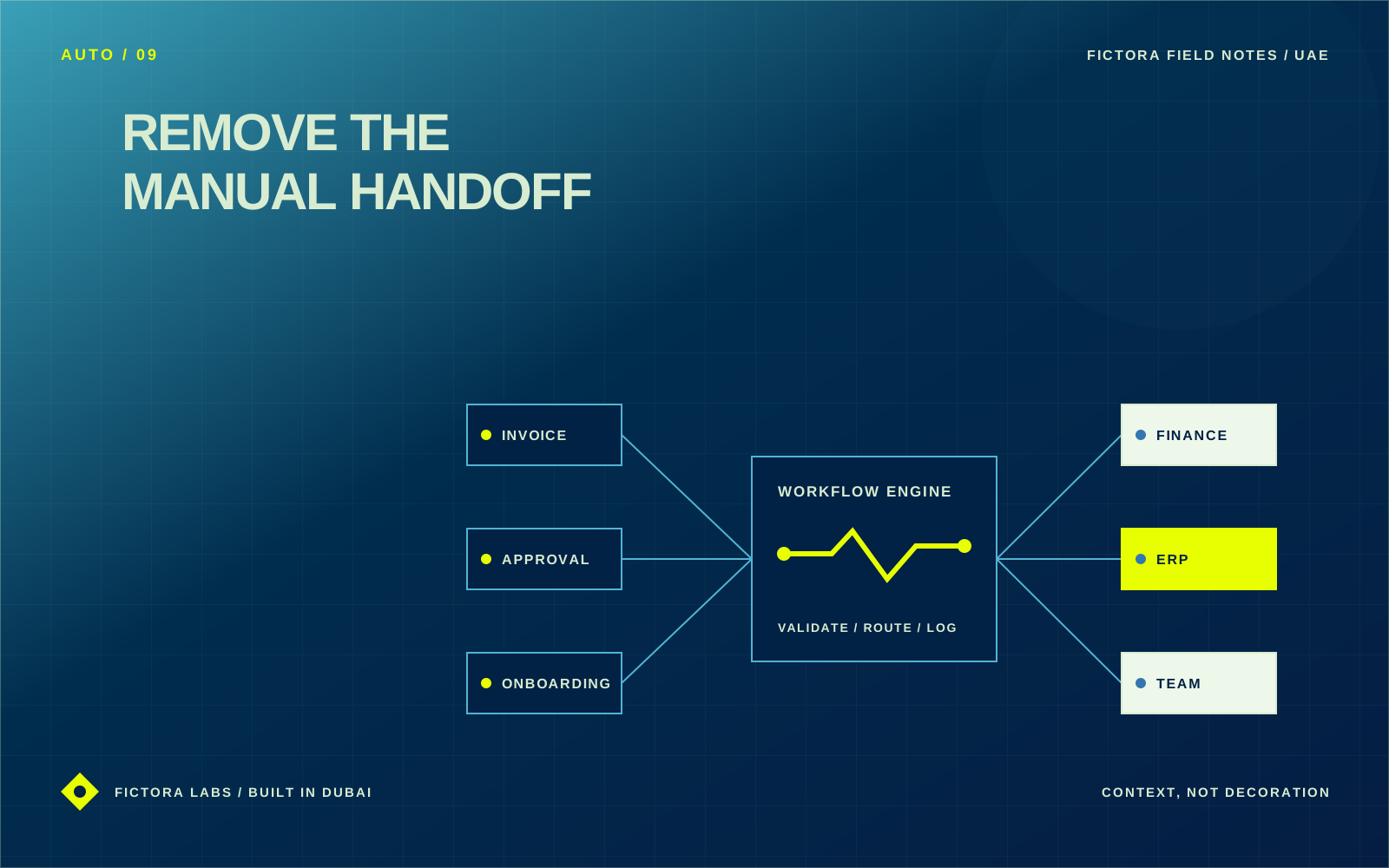
"Which automation tool should we use?" is the wrong first question. The right first question is "which automation tool matches our UAE constraints — data residency, PDPL, Arabic-English handling, WhatsApp Business Platform integration, and AED budget — for the specific workflow we're trying to build?"
This is a UAE-first comparison of the six automation platforms UAE SMEs actually evaluate in 2026: n8n, Make (formerly Integromat), Zapier, Microsoft Power Automate, Zoho Flow, and HubSpot Operations Hub. Every claim below either has a linked primary source or is Fictora Labs' first-hand experience from running our own site automations on this stack.
What "Best" Actually Means for a UAE Business
Rankings that call one platform "the best" for everyone are marketing exercises. In a UAE business, the choice is decided by five specific constraints that don't apply the same way in Europe or the US:
- PDPL alignment. The UAE Personal Data Protection Law (Federal Decree-Law No. 45 of 2021) applies to any automation that processes personal data about individuals in the UAE. Whether the tool lets you honour consent, access, erasure, and cross-border transfer basis matters more than which app connectors it has.
- Data residency and hosting. Where the automation platform stores your customer data affects both PDPL compliance and how you present the answer to enterprise buyers. A self-hosted tool inside your own UAE Azure region is a different conversation than a US-only SaaS.
- WhatsApp Business Platform support. WhatsApp is the default UAE business channel. Whether the automation can send and receive on the official WhatsApp Business Platform — or requires unofficial workarounds — decides whether you can even build the workflow the customer expects.
- Arabic-English handling. Any workflow touching customer communication needs to route Arabic and English cleanly, ideally in the same conversation.
- Cost realism in AED. Global pricing pages quote USD. A CFO signing off on an ongoing platform commitment wants AED forecasts, not exchange-rate approximations.
The six tools below all handle simple workflows well. Where they diverge is on these five constraints.
1. n8n
What it is. An open-source workflow automation platform. You can either use n8n Cloud (managed by n8n) or self-host on your own infrastructure — including a UAE Azure region.
Best fit for UAE SMEs. Teams that want data residency control, or that need to build workflows more complex than "when X, do Y" — for example, a multi-step flow that reads a WhatsApp message, classifies intent with an LLM, writes to Notion, and pings a team channel only when the message needs a human. This is the platform Fictora Labs runs its own website lead-intake pipeline on.
PDPL and residency. Self-hosting gives you full control — you decide the region, the retention, the encryption at rest. This is the strongest option in the six for a UAE business that will be asked "where does customer data live" by a regulator or an enterprise procurement team.
WhatsApp Business Platform. Supported via HTTP webhook and community nodes; also supported via integration with Business Solution Providers (360dialog, Twilio, MessageBird).
Arabic-English handling. n8n itself has no language dependency; how well Arabic routing works depends on the LLM or logic you connect it to, not the platform.
Cost. Self-hosted is effectively free of platform licensing (you pay for your own hosting — small VPS from ~AED 40/month upward). n8n Cloud starts around USD 20/month for the Starter tier per n8n's pricing page.
2. Make (formerly Integromat)
What it is. A visual workflow builder with a strong node-based UI. You compose "scenarios" by dragging modules onto a canvas and connecting them.
Best fit. Teams that want a mid-complexity workflow tool with a wide connector library and a visual editor that's easier to hand off to a non-developer than n8n. Common UAE use case: multi-app data synchronisation across common SaaS tools.
PDPL and residency. Make runs on EU and US infrastructure with no UAE region option; there is no self-host path. For PDPL compliance you need a data-processing agreement with Make and a documented cross-border transfer basis.
WhatsApp Business Platform. Available via HTTP module or via WhatsApp connector modules that call Business Solution Providers.
Arabic-English handling. UI is not natively localised for Arabic; scenario logic itself handles any language.
Cost. Free tier available; paid tiers start around USD 9/month (Core) per Make's pricing page.
3. Zapier
What it is. The widest-connector automation tool on the market — supports thousands of apps with the shallowest learning curve.
Best fit. Teams that want speed-to-deploy on simple, low-volume workflows across common SaaS tools. Common UAE use case: connecting form submissions to a CRM without waiting for a developer.
PDPL and residency. Zapier runs on US infrastructure; no UAE region. Same PDPL treatment as Make — DPA plus documented transfer basis.
WhatsApp Business Platform. Available via third-party Business Solution Provider integrations (360dialog, Twilio); no first-party WhatsApp integration.
Arabic-English handling. UI is not localised for Arabic; workflow logic is language-agnostic.
Cost. Free tier available; paid tiers start around USD 19.99/month (Professional) per Zapier's pricing page.
4. Microsoft Power Automate
What it is. Microsoft's automation platform, bundled with Microsoft 365 Business Premium and other M365 tiers, or licensable standalone.
Best fit. Teams that already run on Microsoft 365 (SharePoint, Teams, Excel Online, Outlook, Dynamics 365). If your organisation has Microsoft 365, Power Automate is likely already available at no extra cost, and its integrations with Microsoft-first tooling are deeper than any competitor's.
PDPL and residency. Microsoft offers a UAE Azure region (UAE North / UAE Central) and lets tenants choose data residency at tenant creation. Combined with Microsoft's enterprise-grade DPA framework, this is the strongest managed-SaaS option for PDPL alignment.
WhatsApp Business Platform. Via connector or via Power Automate's HTTP action to a Business Solution Provider.
Arabic-English handling. UI is available in Arabic; workflow logic is language-agnostic.
Cost. Included in Microsoft 365 Business Premium; standalone Power Automate Process plan around USD 15/user/month per Microsoft's pricing page.
5. Zoho Flow
What it is. The workflow automation piece of the Zoho ecosystem. Deep first-party integration with every other Zoho product (CRM, Books, Inventory, Desk, Campaigns).
Best fit. Teams already inside the Zoho ecosystem, especially UAE SMEs running Zoho Books for VAT-compliant accounting and Zoho CRM for lead management. Zoho is one of the more widely adopted business suites in the UAE SME segment.
PDPL and residency. Zoho lets customers choose their data centre region during onboarding; India, US, EU, and Australia are typically offered — no dedicated UAE region as of writing. PDPL compliance again rests on DPA plus documented transfer basis.
WhatsApp Business Platform. Native WhatsApp Business integration via Zoho's own connectors.
Arabic-English handling. Zoho products support Arabic UI; Flow itself is language-agnostic in its logic.
Cost. Standard plan around USD 10/organisation/month per Zoho Flow's pricing page; deeply discounted if bundled with Zoho One.
6. HubSpot Operations Hub
What it is. HubSpot's automation and data-sync layer on top of its CRM. Not a general-purpose workflow tool — it's specifically for teams already running HubSpot.
Best fit. Teams whose primary system of record is HubSpot CRM and who need automation focused on CRM data quality, sales sequences, marketing lifecycle, and cross-object workflows.
PDPL and residency. HubSpot hosts primarily in the US and EU; no UAE region. Same PDPL treatment as Make/Zapier.
WhatsApp Business Platform. Native WhatsApp Business integration (paid tiers).
Arabic-English handling. UI includes Arabic; workflow logic language-agnostic.
Cost. Starts at USD 20/month for Operations Hub Starter; Professional and Enterprise tiers rise substantially per HubSpot's pricing page.
Comparison Matrix
| Tool | Self-host option | UAE data-region | Native WhatsApp Business | Arabic UI | Free tier | Starting paid tier |
|---|---|---|---|---|---|---|
| n8n | Yes (self-host in UAE Azure) | Yes via self-host | Via HTTP / community nodes / BSP | Not localised | Community edition free (self-host) | ~USD 20 / month (Cloud Starter) |
| Make | No | No (EU/US only) | Via HTTP module / BSP | Not localised | Yes | ~USD 9 / month (Core) |
| Zapier | No | No (US only) | Via BSP integrations | Not localised | Yes | ~USD 19.99 / month (Professional) |
| Microsoft Power Automate | No | Yes (UAE North / UAE Central) | Via connector / HTTP | Yes | Included in M365 Business Premium | ~USD 15 / user / month standalone |
| Zoho Flow | No | No (IN/US/EU/AU) | Native (Zoho connector) | Zoho suite supports Arabic | No (paid only) | ~USD 10 / org / month |
| HubSpot Operations Hub | No | No (US/EU) | Native (paid tiers) | Yes | No (paid only) | ~USD 20 / month (Starter) |
All pricing is quoted in USD because that is how the vendors publish it; convert to AED at your current exchange rate and add any local reseller markup. Verify against the vendor's live pricing page before committing — the numbers above were sourced on 13 September 2026 and vendor pricing changes.
How to Choose — a UAE-First Decision Framework
Rather than "which is best", walk through these six questions in order. Whichever tool answers the most confidently is the one to pilot.
- Where does your customer data have to live? If the answer is "in the UAE" for regulator, enterprise-procurement, or investor reasons, only n8n (self-hosted) or Microsoft Power Automate (UAE Azure region) give you a clean answer.
- What's your existing platform gravity? Already on Microsoft 365 → Power Automate is free with your licence. Already on Zoho → Zoho Flow. Already on HubSpot CRM → Operations Hub. Do not pick a tool that fights your existing stack.
- How central is WhatsApp? If WhatsApp is the primary customer channel, prioritise tools with native WhatsApp Business Platform integration (Zoho Flow, HubSpot Operations Hub) or accept that you will connect through a Business Solution Provider (n8n, Make, Zapier, Power Automate).
- Who will maintain the automation? Non-developer team member with visual patience → Make. Developer or technical operator → n8n. IT team in a Microsoft shop → Power Automate. No dedicated automation owner → the answer is not any tool, it's a partner.
- What is the FTA e-invoicing exposure? If your business is close to the AED 50M revenue threshold that triggers Phase 1 of the FTA e-invoicing mandate in 2026-2027, choose a tool that can integrate with an Accredited Service Provider before automating anything else in finance.
- What can you afford to run for 24 months? Automation ROI compounds. If you cannot commit to running the tool for at least two years, either pick the free tier or reconsider automating this process now.
The Stack Fictora Labs Runs
Our own website lead intake, careers pipeline, and internal reporting run on n8n (self-hosted for data residency), with Notion as the durable data layer, and Zena (our own WhatsApp AI product) handling the customer-messaging surface. This is not the right stack for every business — it is the right stack for one that wants full data-residency control and a UAE-first WhatsApp experience. See how our own website lead intake works end to end, or read the ROI framework in is AI automation worth it for UAE SMEs?
Ready to Choose and Build?
Fictora Labs helps UAE SMEs evaluate the six tools above against their specific workflow, PDPL exposure, and integration constraints — then builds the pilot workflow on the chosen stack.
Talk to us about your automation stack →
Fictora Labs is a DFHQ-recognised AI automation and digital marketing agency based in Dubai, UAE. Our AI workflow automation service covers evaluation, build, and operations across the full six-tool landscape.